Showing posts with label NHL. Show all posts

Friday, July 24, 2015

Stepan, Glass, the Rangers' State-of-Salary-Cap, & Their 2016 Offense?


1) The Rangers have about $6.75 million in cap space to sign Derek Stepan.

Etem, Lindberg & Miller will gain the right to salary arbitration after their current contracts expire by playing in 10+ games next season. So we make the assumption it will happen.


   While the Rangers may actually have only 21 or 22 roster spots come October 1st, the idea is to represent a 14th forward (designated at Jayson Megna in the graph,but could easily be Luke Adam, Brian Gibbons, or Matt Lindblad; all of whom have identical contracts). Because if a team is to pack a roster to the absolute salary cap ceiling, as the Rangers are likely to do, you want to hedge against a string of handcuffing injuries.

   Yes, if a player is hurt for a long stretch of time, he may be placed on Long-Term-Injured-Reserve… in which case the team would receive compensatory cap space to replace the injured athlete’s roster spot. But injuries only lasting a few days or weeks would not qualify, and thus the team would be expected to replace the injure player’s manpower WITHOUT any cap relief.

   Thus, for the sake of this reality, we submit any NHL team’s cap situation based on it carrying 23 players. And like we said, Megna’s assumption as the 14th forward would have identical cap implications as that of Adam, Gibbons or Lindblad. Or, if homegrown AHL’ers Marek Hrivik ($575,000 cap hit) or Ryan Bourque ($562,500 cap hit) earn the title of 14th forward in training camp, then the Rangers would have an insignificant $25,000 to $37,500 extra in cap space than demonstrated in the above image.

   Remember, a team’s salary cap cost is a rolling, cumulative total. Which means if a team is $1 million below the salary cap for the first half of the season, it earns the right to go $1 million above the cap for the second half. This is why the now-defunct Capgeek infamously and brilliantly measured a team’s ‘future cap space’ for the upcoming trade deadline in a given season; a team $1 million under the salary cap in November or December could be projected to have much more cap room come February or March.

   Thus if the Rangers pack the roster to the absolute cap ceiling in aggregate of 23 players come October 1st; by luckily and hopefully staying healthy, the team could only carry 21 or 22 players for as much time as possible, which would allow the same group of 23 players to have considerably more cap space at a given time later down the season.

   In any event, barring an August or September trade, the Rangers must re-sign Stepan to something below $6.75 million.

2) Does Tanner Glass return to Broadway next season?


   The fact that Glass was not jettisoned from the roster in June or July suggests that there is a very likely chance of his continued role on the team. However, we continue to insinuate that Glass is the most expendable asset on the roster, should the team need even a few hundred thousand more dollars in cap space going forward.

   We’ve posted a tongue-in-cheek conspiracy theory, half-seriously suggesting the idea that a trade to dump Glass for cap space is already lined up, but his presence on the roster during Stepan negotiations serves a fruitful purpose as to keep Stepan’s asking price (and realistic expectations) lower than they would were Glass be already exiled, and New York had more available cap space. 

   Put it like this: if Glass were traded away in June or July, and his exiled roster spot were theoretically replaced by Adam, Gibbons, Lindblad, Hrivik or Bourque… the Rangers would have approximately $7.6 million in cap space (instead of their current $6.75 million). Stepan’s camp could, in turn, more reasonably demand a cap hit north of $7 million, without the Rangers camp pointing to a chart of their salary cap space and saying ‘we simply don’t have that liquidity available.’

   Aside from this cute idea, there’s not much value to Glass and his $1.45 million cap hit remaining on a roster so hard-pressed for cap space.

   Yes, Glass is the only fighter/goon on the current roster. But in the modern NHL, where incoming players are required to have visors and penalized for removing helmets in a bout of fistacuffs… the hard truth remains that the ability to fight is a dying necessity for an NHL team to have. It may sell tickets or accumulate hits on YouTube, but it seems less and less a vital ingredient to Stanley Cup contenders.

   Consider this:

   If the Rangers traded away Glass, and signed a goon for the league-minimum $575,000/year… it would result in $875,000 in gained NYR cap space.

   If the Rangers buried Glass in the minor leagues, as they have done with Wade Redden, Aaron Asham & Darrol Powe… and replaced Glass’ roster spot with a $575,000/year goon of similar-or-equal contribution… it would still result in $350,000 gained in NYR cap space.

   There’s very little argument for Glass to remain a Ranger next season, even if one concludes having a scrapper on the team is indeed required. 

3) How could NY trade Glass when he has such a relatively high cap hit compared to his relatively low worth?

   No, Glass won’t have much trade value on the swap market. This is true.

   But his front-loaded contract, nearing its back end of existence, provides some inherent value in of itself: Once Glass receives his 2015 signing bonus ($450,000) sometime between July 1 and October 1 (depending on how its structured in his contract)… for the remaining 21 months of his contract will feature something very attractive to low-market teams: he will be getting $1.45 in cap hit for every $1 actually paid.

   You know why the Arizona Coyotes acquired Chris Pronger’s fossilized contract, with no intent to put him on LTIR in September? Because for only $575,000 of actual salary, they receive $4,941,429 in salary cap credit, which helps the financially-challenged team reach the NHL cap floor at a massive discount. The same logic applies to why the Florida Panthers acquired the contract of Marc Savard ($575,000 in actual cost for $4,027,143 in cap credit).

   While Glass is surely not such a bargain for that scheme, his $1.45-for-$1 cap-credit-for-actual-salary advantage remains there. As of right now, the teams with the lowest salaries are The NJ Devils, Nashville Predators & Anaheim Ducks. All are technically above the cap floor, but still may be attracted to the scheme of Glass’ contract rather than its actual skill-on-the-pill merits.

   Of course, the Rangers could always ‘pay’ a team to take Glass. While trading Glass and a 6th round draft pick for a team’s 7th round draft pick is hardly fruitful, something along those lines remains practical and possible. 

4) How Much will Derek Stepan receive?

   This has been the question, and we’ve poked around at it since last winter.

   Here’s the scoop:

   Since Stepan is the one who filed for arbitration, the Rangers choose whether the hearing will determine a binding 1-year or 2-year award. Stepan would be a restricted free agent once more in the event of a 1-year award (where the Rangers could not negotiate a long-term deal with him until January 1st, 2016). Or, Stepan would be an unrestricted free agent upon contract expiration should the Rangers opt for a 2-year award.

   It’s tough to tell, but we surmise Stepan’s cost to scale from $6 million to $7 million per year, steadily increasing as the length of a deal (1 year to 8 years) increases as well. 1-year for $6 million all the way to 8-years for $7 million/year would be our guess. Of course, its speculative, and the insertion of potential job security (No-Trade-Clause and/or No-Movement-Clause) would skew any figurative scale.


   Ryan O’Reilly’s 2-year contract signed last summer for $6 million/year is a pretty direct comparable to that of what Stepan’s objective worth could be. It can be used as evidence in a potential arbitration hearing, because O’Reilly signed it when he was at the same point in his contractual career as Stepan is now, unlike the contract he more recently signed with Buffalo, where he was an impending unrestricted free agent.

   Subject to change, or flat out being totally inaccurate, we’d suggest Stepan’s relative worth to signing a deal (or being awarded one in arbitration) is something like:

1 year - $6,000,000 / year
2 year - $6,150,000 / year
3 year - $6,333,333 / year
4 year - $6,500,000 / year
5 year - $6,700,000 / year
6 year - $6,900,000 / year
7 year - $7,000,000 / year
8 year - $7,050,000 / year

   If this scale is anything resembling the truth, then the Rangers could re-sign Stepan to anything 5 years or under, and theoretically be able to sit back and stand pat on the current roster without further need to tweak it. Should the Rangers & Stepan amicably hash out a deal for 6, 7 or 8 years… then trading Glass (or some asset carrying relevant cap space) would become imperative.

   Here is a more elaborate dive into how much Stepan may actually be worth according to Ryan Lambert of Yahoo! Sports

5) Assuming Stepan is re-signed, how does the Rangers’ offense look for next season?

   Again, highly speculative, but we did some work projecting how many goals each contracted Ranger could be expected to produce for the 2015-16 season. Of course individual injuries or issues can wildly skew these projections, but we figure a sum of approximately 222 goals is what to expect.


   If this is the case, that 222 goals represents 17th most in the 2014-15 NHL, 1 less than the Winnipeg Jets but 2 more than the Chicago Blackhawks. 

   As the Rangers Top-6 defense, and starting goaltender, will be the same next season as it was last season… Should the Rangers repeat the figure of 187 goals allowed (which was 3rd least in the NHL behind Montreal & Chicago), that’s a projected goal differential of +35. It would be a dramatic decrease in the Rangers’ league-leading +60 of last season, but still good enough to be 6th highest in the NHL, comparing to 2014-15 stats.

   Again, this is highly speculative, so take it with a grain of margin-for-error salt.

Conclusion

   Once the Rangers, be it via mutual agreement or arbitration result, have locked up Stepan’s services for at least another season… the team looks to remain a playoff-bound group of players, even if repeating an NHL Presidential Trophy seems unlikely. Again, while trading pieces like Glass or Dylan McIlrath may indeed occur between now and opening night, one should assume a quiet stretch of time of the Rangers’ offseason once Stepan drama comes to an end. Expect a boring 4-6 weeks in Rangerstown leading up to the dawn of the regular season.

   The temporary uncertainty revolving around Stepan's inevitable new contract aside, there's no reason to suspect the NY Rangers will be anything but a competitive NHL team next season.

Wednesday, July 1, 2015

3 Questions the NY Rangers Will Answer This Summer

  1. Do the Rangers have much salary cap room to pursue free agents?
   No, they do not.

(Note: If Brady Skjei is NOT ready for the NHL roster, he can remain in Hartford (AHL), and a $925k 7th defenseman can be signed in free agency)


   Looking over the NY Rangers salaries (estimates of Restricted Free Agents are in purple), the Rangers really only have a few million at most to spend on a few depth forwards. Unless they trade a major contract, which doesn’t seem terribly likely… this offseason will be quiet for Rangers fans. Which, honestly, isn’t a bad thing as this summer’s free agent class seems a bit stale compared to previous summers.
  1. Will the Rangers keep Kevin Hayes at [3rd line] center, or revert him back to his natural position of winger?

   We’re not sure, but probably not.


   Hayes struggled as center in the postseason, often losing his minutes under Stepan & Brassard to that of 4th center Dominic Moore. In fact, during the regular season, Kevin Hayes finished DEAD LAST in league-wide face-off percentage (minimum 100 face-offs taken) sporting a shameful 36.3%. While Hayes, 23, finished 7th in rookie-of-the-year (Calder Trophy) voting… it seems being a centerman is not his forte.

   Viable options?

   Oscar Lindberg

   A restricted free agent (without arbitration rights) with a qualifying offer of $709,000… we’d estimate a 1-year deal worth about $725,000 or a 2-year deal worth $800,000. Lindberg played heavy minutes (as a center) in Hartford last year, and all indications point towards a serious chance at making the NHL roster in October. Can he be trusted with 3rd line minutes? Would having a couple of youngsters like Hayes & Lindberg on the 3rd line be good enough for a team concerned with immediate contention? If the Rangers don’t pursue any free agent centers this summer, it’s a good bet they’ll be relying on Lindberg from the getgo.


   Riley Nash

   A somewhat surprising unrestricted free agent, as the Carolina Hurricanes did not offer the 26-year-old center a qualifying offer this week, making him (somewhat surprisingly) available to the open market. Nash scored 25 points in 68 games last season, winning 50.9% of his 958 face-offs. While there’s a very good chance Nash will receive offers from other teams in excess of $1 million/year (which is more than the Rangers could realistically offer), Nash seems like one of the most attractive options for a 3rd center. He averaged 16:19 minutes per game last season, and was one of Carolina’s top penalty killers, averaging 1:41 kill time per contest. A long shot, but certainly an attractive idea for Broadway to, at the very least, investigate.


   Mark Arcobello

   Another surprising non-qualification was that of Arizona not tendering Arcobello, who played 77 games for 4 different teams last season. Arcobello, 27, won 50.2% of his 939 face-offs overall last year, while averaging just under 15 minutes per game, perfect for a 3rd line center’s role. The combination of bouncing around the league AND not being offered a mere $630,000 minimum qualifying offer may raise flags as to his ability in the league. Yet if his price is that low, he may be just the type of reclamation project Glen Sather could gamble on, sporting a low-risk low-reward offering. 


   Cody Hodgson

   An unrestricted free agent who was just recently bought out by the revamping Buffalo Sabres. Hodgson, drafted 10th overall 7 years ago, had an impactful rookie year with the Vancouver Canucks before getting traded to Buffalo in 2012. While his 2012-13 & 2013-14 seasons in Buffalo were acceptable (78 points in 150 games)… his 2014-15 season was a complete abomination. Not unlike the Sabres overall team performance, he scored an abysmally few amount of goals (6 goals in 1,002 minutes), leading to his recent contract buyout.
   Should Hodgson be in a position to sign for less than $1 million/year (which seems likely), the Rangers could be an interested suitor. Additionally, if Hodgson signs for under $1 million/year and turns out to be an undesirable forward, he can be buried into the minors without effecting the Rangers cap hit with a burial fee. Or, if Lindberg is the go-to 3rd center, Hodgson’s use as a taxi squad extra forward seems like an imaginable fit.


   Brad Richards

   An unrestricted free agent coming off a Cup-clinching campaign, Richards is one of the 28 eligible UFA skaters able to sign a performance bonus loaded contract. While his net worth will be certainly over $1 million/year (he signed for double that last summer)… the Rangers could feasibly acquire his services with a 1-year contract for $1 million or less in base pay (cap hit), but offer anywhere from $1 million to $4 million in (easily attainable) bonuses. We wrote about the NHL cap-crunch likely forcing teams to rely on performance-bonuses to accommodate the salary cap ceiling this summer, and a returning Richards could be an ideal specimen for the Rangers. However his age, and his potential stamina (he’s played 206 NHL games since October 2013) could raise concerns. Unlike other candidates we’re examining, Richards’ age means if he signs, his cap hit cannot be removed from the Rangers’ book via burial. With so little cap space, this could render the potential risk more than potential reward (unlike small-contract signings under the age of 35 who CAN be buried).


   Stephen Weiss

   Another UFA via buyout, Weiss’s career has been in a tailspin since his time with the Florida Panthers where he notched 394 points in 654 games from ages 18 to 30. After a season-ending injury in 2013, he never returned to his calibre after signing with the Detroit Red Wings that following summer. His injury problems have lingered, and questions of his remaining role in the NHL are rampant. Weiss, 32, would likely sign a relatively cheap 1-year deal with a team, should any team want him, to try and regain his previous form. Unlike expectations in Florida & Detroit, Weiss would clearly be expected to play sheltered minutes, likely playing between youngsters J.T. Miller, Emerson Etem, Jesper Fast and/or Kevin Hayes. 


  1. Do the Rangers need to pursue a 3rd-or-4th-line forward specializing in penalty killing to fill Carl Haglein’s departure?

   This is an interesting question… here’s why:

   Hagelin (1:57 per game) was the Rangers’ premier winger to kill penalties, ranking just below Dominic Moore (2:07 per game) in shorthanded situations. Broadway finished 3rd in the East (and 6th in the league) in penalty killing, due in great part to Hagelin’s speedy defensive prowess. Etem, whom Hagelin was traded for last weekend, only averaged 0:27 of kill time per game. In other words, all else equal, that’s a full 90 seconds per game of “lost” kill time amongst forwards heading into July.

   To exacerbate this deficit: we have to seriously wonder if Moore, who turns 35 next month, can sustain over 2 minutes per game effectively, let alone call on him to increase his kill time any additional time. So the case may very well be the Rangers needing to replace as much as 2 full minutes from forwards.

   Does Broadway have options?

   Enter: Jesper Fast, current restricted free agent whom cemented his regularity on the roster as a full-time NHL’er last season. Fast marveled in defensive roles, averaging 1:06 penalty killing time per game. And at the ripe age of 23, Fast is an ideal candidate to (realistically) play more penalty kills without causing detriment to the team. 


   So let’s say Fast’s PK time-per-game jumps a full minute (from 1:06 to 2:06, which would be 1 second less than that of Moore’s).

   That still leaves (perhaps) a full 60 seconds of PK time per game to be sourced from somewhere.

   Stepan & Nash averaged 1:35 & 1:20 per game respectively. Considering both play top minutes during even strength as well as power play, it seems unlikely they could have much more to give. 

   Tanner Glass played 1:01 per game, and could feasibly have his time increased in this capacity. But a full minute more? Doubtful.

   This leaves Hayes (0:26), Zuccarello (0:22) & Brassard (0:14) as other PK’ers… of which are also unlikely to make effective jumps.

   So the real question is: how much will the current Rangers supplement Hagelin’s departure & Moore’s aging downslope?

   If the Rangers believe the deficit can be reduced to only 30 seconds of time missing, it won’t be a huge priority to seek assistance on the market. Conversely, if the Rangers are counting on a depth signing to make a relevant impact… the names of potential 3rd line centers we mentioned above may be pursued in order of PK ability. (Riley Nash with perhaps the most valuable PK skill set, playing 1:41 per game… and Brad Richards with the least valuable PK skill set, logging only 1 second on the kill per game).

Conclusion

   These 3 questions will be answered, one way or another, this summer. If Broadway makes a trade, say an exodus of Kevin Klein ($2.9 million per year cap hit) or Tanner Glass ($1.45 million per year cap hit)... that should indicate a potential change in cap space, let alone whatever the return should indicate. If the Rangers pursue a free agent center, it could indicate an insurance policy should Oscar Lindberg not be able to handle 3rd line minutes in October (though it would definitely indicate intent to place Hayes back on the wing). And finally, the franchise's faith in stepping up its penalty-killing depth amongst forwards (again, hedging against Lindberg's hit-or-miss role) should tell us how badly it views Hagelin's absence for shorthanded scenarios.

   Personally, I suspect a quiet off-season for New York, without any more trades or "big" names entering our headlines. However, given the topics we've discussed, there'll major team logic to infer from even the depthiest of depth signings. 

   Let free agency begin!


Friday, June 26, 2015

Talbot Trade Tinkering: Final Edition


   We’ve written a lot about Rangers understudy goaltender Cam Talbot on this blog over the months. With the NHL Draft beginning tonight, and Talbot’s trade highly likely, I thought we’d submit one more piece pertinent to Talbot.

   In our March 5th article Sather’s Busy Summer, we vaguely speculated whether Talbot would be cost-cutting tradebait come the offseason.

   In our March 20th article Cam Talbot’s Value & The 2015 Goalie Market, we were the first to break down the looming probability of Talbot’s worth in a trade. It was easy to conclude that Buffalo, Calgary, Edmonton & San Jose would be the logical suitors of Talbot’s reception. 

   A week ago we listed the Top 10 (Realistic) Cam Talbot Trades during draft weekend, speculative of how valuable an asset Talbot would be to the highest bidder.

   On Wednesday we suggested Talbot’s expulsion was inevitable, as the NY Rangers will need to cut Talbot, and at least one additional Ranger, to adjust to the $71.4 million salary cap next season.

   Today I’d like to briefly suggest some alternative possibilities of return via trading Talbot. While budgetary reduction will be a paramount priority for Broadway this summer, it doesn’t completely rule out the idea of acquiring cheaply-contracted bodies in the looming Talbot deal.

   So what about a Talbot trade involving….?


Chad Johnson (Buffalo Sabres)


   Similar goalie to Talbot in the sense of contract and history as the Rangers backup. Johnson has one year remaining in his contract ($1.3 mil cap hit) before Unrestricted Free Agency in July 2016, also like Talbot. A bodily exchange of Johnson for Talbot alone would only be a net cap hit savings of $150,000 for the Rangers (they need to cut 10 times that this summer). However, if Johnson’s salary were to be retained by Buffalo, the “cap savings” for the Rangers could range from $150,000 to $800,000. Johnson has backed up 3 different NHL teams in the past 3 years (Arizona, Boston & Islanders) racking up 50 NHL games since leaving the Rangers organization in 2012. Johnson recently turned 29 years old.


   Joni Ortio (Calgary Flames)

   Calgary’s 3rd string, AHL-starting goalie, who’s been making a lot of noise about capability to transition into the big league. Ortio has played 97 AHL games with the Flames’ affiliate minor league team, and played 6 NHL games this past season. If Calgary is apt to acquire Talbot, having he and Jonas Hiller as a tandem next season… that would leave the 24-year-old Finnish goalkeeper looking for a new franchise with more opportunity. With goalie prospects Mac Skapski, Brandon Halverson & Igor Shesterkin are 3 or 4 years younger than Orito, it would give New York an immediate option to backup Lundqvist in October, while allowing the pipeline prospects to continue to develop below. Ortio's cap hit clocks in at $600,000; attractive to a team like the Rangers as it's only $25,000 above the league minimum.


 Oscar Klefbom - Edmonton Oilers


   Edmonton’s Swedish prospective defenseman whom has played 77 NHL games despite being 21 years of age. More impressively, Klefbom averaged 21 minutes per game for the dreary Oilers last season, impressing the hockey community with his tremendous upside. Klefbom is on the final year of his entry-level contract, which carries a meek $894,167 cap hit (with up to $350,000 in performance bonuses). If Broadway is looking to cut salary, and perhaps include Kevin Klein in a deal… Klefbom for Klein would save the Rangers just north of $2 million in cap savings next season. With a rich crop of budding NHL defensemen, including Martin Marincin (23) & Darnell Nurse (20)… Edmonton could be subject to unloading one of their bullion bluechips at a shot in acquiring a potential franchise goalie in Talbot.


Nail Yakupov - Edmonton Oilers


   The former #1 overall pick in 2012, Yakupov is signed for 2 more seasons at $2.5 million per season. Should the Oilers retain more than 42% of Yakupov’s salary, a straight-up swap for Talbot would be a payroll cut for the Rangers. But for more materialistic speculation, consider these subjective nuggets of thought:

  • To Rangers fans, Yakupov trade rumors have a reminiscent feel to that of a former “Glen-Sather-reclaimation-project” in that of Nik Zherdev. Yakupov has hardly smashed the league with goal-scoring since his debut (42 goals in 192 games), yet was clearly taken #1 overall for his offensive potential. Should Carl Hagelin be cut from Broadway for salary reasons, Yakupov would be a perfect fit for New York’s 3rd line.
  • Even more of an “out there” train of thought: the Rangers have not had a Russian-born NY Ranger since the days of Fedor Tyutin (who was coincidentally sent to Columbus for Zherdev). Is that relevant? Probably not. Except: If the Rangers want to woo European prospect Pavel Buchnevich to North America next season, having one of the highest-touted Russian youngsters in the lockerroom certainly couldn’t hurt. Buchnevich cited his English was extremely poor, so there’s probably not much allure to a franchise full of folks who don’t speak the language. Remember how Sergei Gonchar acted as a translator for Evgeni Malkin in his rookie year? If attempting to persuade Buchnevich to come to Rome, besides money, it could be an additional boon in having young Yakupov.

2016 Draft Picks?

   If the NY Rangers can’t get what they want in 2015 draft picks, probably due to a miscommunication of Talbot’s specific value in terms of picks… another option is acquiring 2015 picks instead. Why?

  • As we showed in our article about the historic measurements of trading draft picks, it seems teams are willing to “gamble” on picks’ particular worth when trading Year 1 pick(s) for Year 2 pick(s). Why would this happen? If two parties are at a mutual disagreement of both assigning value AND where their team will finish next season in the standings? It presents itself as a mutually amicable atmosphere for a now-for-later draft pick swap.

      If the Edmonton Oilers believe they will be a contending team in 2015-16, but don’t think Talbot is worth the #16 overall pick tonight… and simultaneously, New York believes Edmonton will flop once again next season, and believe Talbot IS worth such a pick… why not trade Talbot for Edmonton’s 2015 1st Round Pick? In this example, Edmonton would think it was giving New York a pick worse than #16, while New York thought it could very well be a BETTER pick. If two teams come to a conflicting conclusion, trading for more uncertain picks in a year can be a practical course of action.

  • Additionally, the NY Rangers could use the 2016 Draft Pick(s) acquired as an arsenal of exportable assets come the 2016 Trade Deadline. If New York finds itself in another successful season, looking to beef up for another deep playoff run, the Rangers offering draft picks to deadline sellers could be a great way of procuring reenforcement come March. 

 Conclusion

   We’ll wait and see how Talbot’s fate plays out as the draft kicks off this evening. With the NY Rangers looking to cut $1.5 to $2 million in theoretical salary cap this summer, the Talbot trade could be an indicator of future moves. Should New York liquidate Talbot for draft picks and non-NHL prospects, we see a significant portion of necessary payroll has been cut, and trimming the rest could be very minor. However, if a equal-or-greater contract is returned, it signals Sather will be inclined to make bigger moves in the coming months to ultimately get a cap-compliant roster.


   Get the popcorn out folks, its NHL Draft Weekend.

Wednesday, June 24, 2015

How The $71.4 million NHL Salary Cap Affects the NYR OffSeason


   NHL General Managers, NHL players, their agents, and the entire hockey blogosphere have learned the 2015-16 salary cap will be $71.4 million. If you’re viewing this blog, then chances are you’re at least a tad bit curious as to the obvious question: How will this affect the New York Rangers?

   The first priority remains the same as our previous weeks of articles: the Rangers must reduce their payroll this summer in order to comply by October 1st. 

    Here’s a look at the NY Rangers cap payroll for the 2015-16 season:

  • The contracts in purple indicate that player is a Restricted Free Agent this summer, and the figure in purple is the minimally realistic prediction as to what they could sign for on a 1-year deal.
  • The contracts in grey indicate that player’s contract is on the books, thus NOT a free agent.
  • The contracts in blue indicate the 2015-16 NHL minimum age as a theoretical cap hit for whatever depth players the Rangers sign this summer. In this instance, the extra skaters are all conservatively presumed to have minimum-wage ($575k/yr) deals.

   Here we see the team looks to be a few million short of being cap-compliant. And this graph represents best-case scenarios for the Restricted Free Agents re-signing at the realistically cheapest 1-year contracts.

   At best, the Rangers are a little less than $2 million over the salary cap this summer, in our extremely conservative estimations.

   So where to cut? Hmmm…

CAM TALBOT
  • Exporting Talbot in a trade, and ultimately replacing him with a lesser salary, is the easiest (and as of late, trendiest) means to reduce overall payroll.Trading Talbot away, and ultimately replacing him with that of a, say, $645,000/year goalie… would be a $800,000 reduction on the team’s books.

DEREK STEPAN


  • In a 1-year contract, we predict Stepan to sign for no less than $6 million. 
  • A multi-year contract would likely range from $6 mil to $7 mil.
  • The most similar comparable to ascertaining Stepan’s theoretical value this summer is that of Ryan O’Reilly in Colorado… O’Reilly signed a 2-year $12 million contract shortly before an arbitration hearing was scheduled.
   Our prediction for Stepan’s year-to-year rate is something like:
  • 1 years: $6.000000 / year ($06,000,000)
  • 2 years: $6.200000 / year ($12,400,000)
  • 3 years: $6.333333 / year ($17,999,999)
  • 4 years: $6.500000 / year ($26,000,000)
  • 5 years: $6.700000 / year ($33,500,000)
  • 6 years: $6.900000 / year ($41,400,000)
  • 7 years: $7.142857 / year ($49,999,999)
  • 8 years: $7.125000 / year ($57,000,000)

   Stepan is an extremely vital asset for Broadway, serving as their wonderfully productive 1st Line Center. Unless traded within the window, there’s two more seasons of Derek to play as a New York Ranger before entering Unrestricted Free Agency. 

  Sather could take the 1-year discount, delaying the probable payday contract to Stepan until next summer… although Stepan’s pricetag could easily (and likely) be higher during this time next summer. 

   Let’s hold off on figuring a course-of-action for signing Stepan until we can appreciate what assets on the team may be more expendable than the team’s #1 center. 

CARL HAGELIN

  • With Restricted Free Agency, Hagelin may be headed to NHL salary arbitration next month, if he and his team cannot hash out an amicable agreement beforehand.
  • Parallel to last summer’s arbitration decision for that of Vladimir Sobotka (in St. Louis)… we feel a 1-year $2.8 million contract is roughly what Hagelin could/should/would be awarded.
   Should the Rangers and Hagelin agree long-term? Our prediction for Hagelin’s year-to-year rate is something like:
  • 1 years: $2,800,000 / year ($02,800,000)
  • 2 years: $3,000,000 / year ($06,000,000)
  • 3 years: $3,333,333 / year ($09,999,999)
  • 4 years: $3,500,000 / year ($14,000,000)
  • 5 years: $3,600,000 / year ($18,000,000)
  • 6 years: $3,750,000 / year ($22,500,000)
  • 7 years: $3,642,857 / year ($24,499,999)
  • 8 years: $3,625,000 / year ($29,000,000)

STEPAN vs HAGELIN?

   This duo represent the the lone pair of NYR Restricted Free Agents to a) have the right of salary arbitration, b) make the most money of any of the other RFA’s, and c) be only two years removed from Unrestricted Free Agency.

WHICH DESERVES A LONG-TERM DEAL MORE?

   The answer, almost irrefutably, is Stepan. He is a #1 center, is a coveted asset to any NHL franchise. A cornerstone center, at the young age of 25, is expected to make $6 or $7 million on  a long-term contract.

   As for Hagelin? Two things to note when pondering his gravity of Broadway’s cap structure:
  • A) Hagelin is a 3rd line winger, with the upside attribute of being a phenomenal penalty killer. 
  • B) Perhaps Hagelin’s most valuable attribute to his contribution to an NHL team is his speed. Yet Hagelin, who turns 27 years old in August, will likely be losing pepper off his footwork fastball.

   In other words, what do you think is the easiest roster change to “correct or “replace” for cheaper money? A $6 million center who plays 19 minutes per game, or a $2.8 million winger who plays 15 minutes per game?

JESPER FAST (24), J.T. MILLER (23) & OSCAR LINDBERG (24)


  • All three forwards are Restricted Free Agents without the right to salary arbitration
  • We predict Miller’s 1-year extension rate is $50,000 more expensive than Fast’s, despite Miller’s minimum qualifying offer being $100,000 greater than that of Miller’s
  • Lindberg, who had a wonderful season in the American Hockey League last season, is fully expected to make the jump to the NHL next year. His qualifying offer is few thousand less than his projected 1-year minimum cost of $725,000

   With all the trade rumors surround Cam Talbot, why don’t we hear too much about any of these assets being included in a packaged trade?

   Because with the trio reasonably projected to make less than $1 million/year on respective 1-year deals… it does not seem an aspect where Broadway can be in a position to “cut the fat.” In other words, what forwards could be returned in a trade which would replace the roles of Fast/Miller/Lindberg while accounting for lesser money? 

   It seems highly unlikely.

   So…

   Let’s assume Cam Talbot is traded somewhere for draft pick(s) and/or prospect(s). And let’s also assume that the Rangers replace his role as Backup Goalie with an Unrestricted Free Agent signing this summer, of whom signs for 1-yr $575,000 (the NHL minimum wage).

   How does this change things?


   So even if all four RFA’s are signed for the most realistically stingy 1-year contracts… and even if Talbot is traded and replaced with a goalie of minimal cost… we see the team remains $275,000 over the cap.

   Not to mention, having the 21st, 22nd & 23rd roster spots all at the NHL minimum wage is a stretch for this example as well. 

   So…?

   Talbot cannot be the only Ranger to be exported this offseason. 
   
   There must be at least one other NY Ranger to be exiled, and replaced with a cheaper substitute, for the team to render itself cap compliant.

   Before we finish, let’s just remind ourselves of which NY Rangers have No-Trade and/or No-move Clauses this summer, making them the peskiest players to attempt to move?


   So while there is a lot of salary cap meat-on-the-bone with this list of NY Rangers… it would seem especially cumbersome to orchestrate a trade involving any one of them. Particularly packaging someone in a Talbot trade to either Edmonton or Buffalo, where one of these players’ approval of such a trade would seem even less likely. 

   So…

   What about the Rangers under contract with the highest cap hits whom are without any NM or NT clauses?


   What can we conclude?

   As we’ve proposed multiple times on this blog, the seemingly most “replaceable” players to dump are Carl Hagelin and/or Kevin Klein.

   Both have theoretical salary caps just south of $3 million, while their respective roles are that of 3rd line wing & 3rd pair defense. 

   McDonagh’s cap hit of $4.7 million is a bargain, considering the Captain’s role on the team.

   Stepan, Kreider & Yandle are all being paid “fairly”, given their respective roles (and Power Play capability).

   Any trade involving Kreider, McDonagh, Stepan, and/or Yandle would be as big a summer surprise as it is (at the moment) highly unlikely.


   Thus, now we see why Kevin Klein & Carl Hagelin have been the most frequent throw-in Rangers skaters mumbled amidst the weeks of Talbot trade rumors. Neither player is a toxic asset (actually both have done very well as Rangers, and would not be traded due to poor performance or sour reputation). Yet when looking for a soul to shed some salary, Hagelin & Klein are the “likeliest” suitors.

   So we will examine two different scenarios:

SCENARIO A:
  • Trade Cam Talbot & Kevin Klein for draft pick(s) and/or prospect(s)
  • Sign Derek Stepan to a long-term deal worth $6.6 mil/yr [which we predict would be a four or five year deal]
  • Sign Carl Hagelin to a 1-year, $2.8 mil deal
  • Sign J.T. Miller to a 2-year, $1.2 mil/yr deal
  • Sign Jesper Fast to a 2-year, $975k/yr deal
  • Sign Oscar Lindberg to a 2-year, $800k/yr deal
  • Sign a 7th D, such as Matt Hunwick, to a 2-year, $875k/yr deal
  • Assume Brady Skjei will be NHL-ready for duties on the Broadway’s 3rd defensive pair
  • Sign a backup goalie to a 1-year, $700k deal ($125k more than the league minimum)
  • Sign a 13th “spare” forward to 1-year, $675k deal ($100k more than the league minimum)
  • Sign a 14th “spare” forward to a 1-year, $650k deal ($75k more than the league minimum)


  • Interestingly enough, we assume if Klein is moved, that the services of Matt Hunwick (hypothetically signed for a  2-year, $875k contract) and rookie Brady Skjei will be enough “in-house” promotion to replace Klein’s role. 
  • To do this, the Rangers must accommodate a seven defensemen with only two Right-handed pointmen. If this is the case, why don’t we slide McDonagh to the right point? He played well at the 2014 Winter Olympics in the off-hand position of RD. 
  • This also frees up enough cap space to sign RFA’s Fast, Lindberg, Miller & Stepan to multi-year “bridge” deals.
  • We can also beef up the 2nd goalie, as well as 13th & 14th “spare” forwards respective cap hits, to a few notches above the league minimum.
   Scenario A brings us to a 23-man roster snugly beneath the ceiling with $50,000 in cap space.

   - Talbot is replaced by a free agent for approximately half of Talbot's 2015-16 salary
   - Klein is replaced by a combination of Skjei & Hunwick
   - Martin St. Louis is replaced by the promotion of Oscar Lindberg
   - James Sheppard & Chris Mueller are replaced by a $675k free agent & $650k free agent respectively


SCENARIO B:
  • Trade Cam Talbot & Carl Hagelin for draft pick(s) and/or prospect(s)
  • Sign Derek Stepan to a 1-year contract 
  • Sign J.T. Miller to a 2-year, $1.25 mil/yr deal
  • Sign Jesper Fast to a 2-year, $975k/yr deal
  • Sign Oscar Lindberg to a 2-year, $800k/yr deal
  • Sign a 7th defenseman to a 1-year, $800k deal
  • Sign a backup goalie to a 1-year, $725k deal ($125k more than the league minimum)
  • Sign a 13th “spare” forward to 1-year, $675k deal ($100k more than the league minimum)
  • Sign a 14th “spare” forward to a 1-year, $600k deal ($25k more than the league minimum)


   - Talbot is replaced by a free agent for approximately half of Talbot's 2015-16 salary
   - Hagelin is theoretically replaced by Fast
   - Hayes switches to wing, while his 3rd center roster spot is replaced by a $1.5 million free agent
   - Martin St. Louis is replaced by the promotion of Oscar Lindberg
   - James Sheppard & Chris Mueller are replaced by a $675k free agent & $600k free agent respectively
   - Matt Hunwick is either brought back for, or replaced by, a $800k free agent defenseman

Scenario B brings us to a 23-man roster snugly beneath the ceiling with $25,000 in cap space.

*Important Note: While the sum of $1.5 million for pursuing a 3rd line winger or defenseman seems awfully underwhelming, the NY Rangers will have as much as $2,505,000 available in performance bonuses to dish out this summer while remaining below the bonus cushion. Should the Rangers wish to "gamble," and assume Kevin Hayes will not activate his maximum potential bonus amount of $2.85 million, the Rangers could theoretically dish out $3 or $4 million in bonuses this summer and still not break the cushion. Thus, a $1.5 million 3rd line forward could actually be compensated $2.5 - $4.5 million in cap-haven performance bonuses, attracting the highest quality of forwards willing to sign on for a 3rd line role.

Conclusion

   These two scenarios seem to be the likeliest ones for a vague picture of the Rangers' team come October. Neither involve trades which tinker with the nucleus of role players pivotal to the team's chances at a Stanley Cup. Simply put: Hagelin, Klein & Talbot will be missed, but not irreplaceably so. 

   There's no reason to think a trade involving Lundqvist, Nash, McDonagh, Staal or Girardi will take place this summer. If not for the unlikely possibility of any of these players waiving there NMC/NTC's, the simple fact that Scenarios A & B demonstrate there should be ZERO pressure at all for Glen Sather to make such a deal.

   Yes, the Rangers need to cut salary. Aptly put, the roster will require metaphorical off-season surgery. Yet while the deportation and replacement of Hagelin, Klein and/or Talbot represent minor surgeries like wisdom teeth removal or laser-eye... why in the world would Broadway go a few steps further and voluntarily engage in open-heart surgery by way of dealing Lundqvist, Nash, Stepan, McDonagh, Staal or Girardi?

   This is not a team looking to make huge adjustments after a largely disappointing 2014-15 season. The team won the President's Trophy, was a viable threat until the end, and was 20 minutes away from their 2nd consecutive Stanley Cup Final. Unlike teams like Colorado, Dallas or Toronto... this is not a team with political carte blanche to rewire all aspects of the roster.

 This is a team that should be considerably more apt to trim around the edges than rebuild its central configuration.
   It doesn't make much sense for the Rangers to move the big pieces... at least not quite yet.


Sunday, June 21, 2015

Battle of the Hudson: Rangers vs Devils in NHL Drafting

Glen vs. Lou
Comparing Draft History from 2000-2011


With the upcoming 2015 Entry-Draft less than a week away, and with rumors that Glen Sather may be leaving the New York Rangers soon, we thought we’d take a look at Sather’s drafting history with the club.  Since 2000, Glen has been at the helm, finding gems in later rounds (Henrik Lundqvist comes to mind) while often choosing poorly in the earlier ones (Cam Fowler comes to mind…).  There have been periods where it seems like the Rangers have gone ages without a solid draft pickup, and there have been years where you have to scratch your head in amazement as the team stocks up on sneaky-good talent.  


This year, the Rangers currently hold five draft picks, none earlier than their 2nd Round, 59th overall.  Though this is one of the latest first picks the Rangers have had in the last 15 years, Sather has certainly grown accustomed to not picking early.  From 2000-2014, the Rangers have averaged the a bit later than the 26th pick overall as their first selection in a given draft.  Much of this has to do with the Rangers recent success, as they have made the playoffs in 9 of the last 10 seasons, thus ensuring their pick was no higher than 15th in the ensuing drafts.  Sather has also made a habit of trading his first round pick in recent seasons, and to varying degrees of success.


The Rangers’ cross-river rival, the New Jersey Devils, have a similar drafting history to the Rangers since 2000.  Lou may be gone, but with these teams going head-to-head for so many years, we thought we would ask the following question: Does Glen Sather or Lou Lamoriello draft better?


MATCHUP 1: TOP PICKS BY YEAR


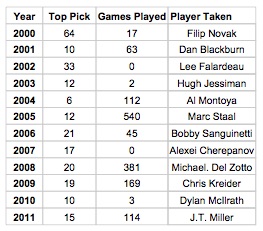
So let’s look at the numbers.  First, we should take a look at each team’s first pick from 2000-2011.  We did not include the picks from 2012-14, as they are still in development.  We also focused on games played, as it is a quality-metric that all three positions share.  How did Glen do?


Glen Sather Drafting History - Sheet1.jpg


Let’s look at the positives first.  Marc Staal is a “franchise” defenseman, Chris Kreider looks like he is turning into a solid power-forward, and J.T. Miller is finally showing the consistency that has been sorely missing from his game.  Those three draft picks alone make up an important chunk of the current roster.  Michael Del Zotto was certainly not a bust in his rookie campaign (37 points in 80 games, including 22 power play points).


Now let’s get to the brutal side of Sather’s drafting career.  Hugh Jessiman’s name was burned into the heart of Rangers fans in a deep 2003 draft, and as we watch Ryan Getzlaf and Zach Parise succeed (they were available for the Rangers to take), we won’t be forgetting anytime soon.  Everybody knew the Rangers were going to draft Cam Fowler in 2010, and yet they took the enforcer-style Dylan McIlrath who seems to always be just outside the Rangers depth chart.  Bobby Sanguinetti managed to get in a whopping 5 games with the Rangers before his career bounced between the AHL, NHL, and KHL.  Last year, he was the top scoring defenseman for the Utica Comets, the AHL affiliate of the Vancouver Canucks.  Not bad for an average hockey player, but not what the Rangers were hoping for.

In fairness to Sather, we must mention that Dan Blackburn sustained a freak shoulder injury that forced him to retire in 2005 at the age of 22.  And of course, the highly touted Alexei Cherepanov never made it to New York, as he shocked hockey fans everywhere, passing away during a KHL game. Hard to fault Sather for these unfortunate events.


For context, let’s take a look at how Lou Lamoriello did over that same period.  From 2000-2014, the Devils have drafted 29th overall on average.  This is just a bit behind the Rangers overall draft position during the same period.  How did Lou do?


Compared to the Rangers, the Devils actually have drafted fairly well with their first pick.  Their best pick is clearly Parise.  Their worst pick is a bit harder to discern.  Adrian Foster never played in an NHL game, but he was taken 28th overall, not 12th like Jessiman.  It is notable that the Devils have not drafted anyone who has played over 200 games since 2005, and that dearth in depth has really started to manifest itself on their roster.  But there is no denying that the Devils struck gold with Parise, and to a much lesser extent, Travis Zajac.  I imagine most Rangers fans would rather have drafted Parise than Staal, but then again, it’s easier to be allured by points than by stout defense.  


ADVANTAGE: It’s close, but Lou Lamoriello


MATCHUP 2: ALL DRAFTING BY YEAR


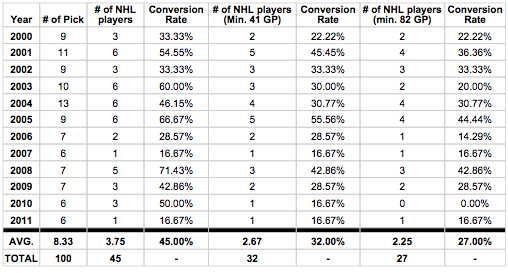
To get a fuller picture, let’s see how the Rangers have done overall under Glen Sather’s leadership.  We took a look at all of the Rangers picks from 2000-2011, and determined what percentage of those picks turned into NHL players.  We broke it down into three groups:  Players who have played a single NHL game, players who have played at least 41 games in their career, and players who have played at least 82 games, or a full season’s worth of games, in their career.  Here are the results:

New York Rangers Drafting 2000-2011
Sather - Conversion Rates.jpg


Overall, the Rangers have drafted a sizable number of players who have put on an NHL jersey at least once in their career.  45% of their draft picks have played at least one game at the NHL level.  When you remove the players who have played less than a full season, that percentage becomes 27%, and this is what we would expect to see.  Many players never make it out of the AHL, and many times those that do only get a whiff at a game or two in the top league.  There just aren’t enough available slots in the roster for every draft pick to make it.

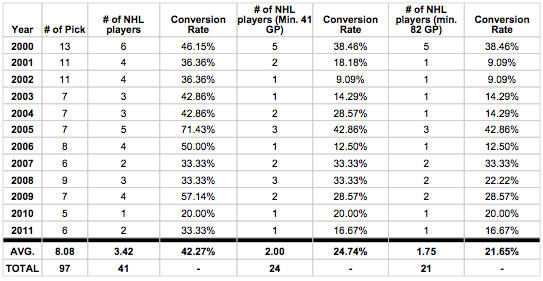
Let’s contextualize this.  How have the Devils done in comparison?  Their drafting chart is below:

New Jersey Devils Drafting 2000-2011
Glen Sather Drafting History - Devils History.jpg


The Devils have drafted only three fewer player than the Rangers over this time-frame, but their overall yield is lower than the Rangers.  Over 42% of the Devils picks have played at least an NHL game, and yet when we compare the number of players who have played a full season or more of games, the difference becomes much more stark.  NHL-ready players have so much more value than a player who has never played a game at the highest level.  These players can help your team in the short term, or be flipped for better players in the long-term.  Sather has had more flexibility at recent trade deadlines because the Rangers suddenly have a solid pool of talent.  The Devils, on the other hand, remained in the Eastern Conference basement as their overall team depth is lacking.  


ADVANTAGE: It’s close, but Glen Sather


MATCHUP 3: CURRENT HOMEGROWN ROSTER


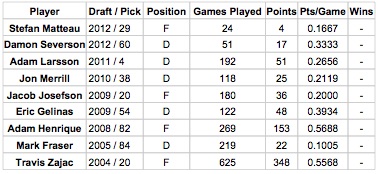
Finally, let’s compare each team’s draft picks from 2000-2011 that ended last season on their respective rosters.  Let’s mix it up, and take a look at the Devils’ current home-grown group:
Glen Sather Drafting History - Best Rangers.jpg
These nine players have combined for 1,800 games in their career.  That averages out to 200 games per player.  It’s an interesting cast of characters, but only three of them have more than 192 games of NHL experience.  There is also not a forward who stands out as “elite”. Adam Henrique has been solid so far, but Travis Zajac is not anyone’s idea of a first-line center, and Jacob Josefson has failed to live up to expectations (11 points in 62 games in his fifth year).


What about the current crop of homegrown New York talent?  There’s a lot to love here:


Glen Sather Drafting History - Best Devils.jpg


Right off the bat, we have 8 players who were integral to the Ranger’s success last year.  To compare with the Rangers, these eight players have amassed 2,825 games collectively.  That’s 353 games per player on average!  And you want to talk about “elite”?  Derek Stepan is an all-situations top-flight center, Marc Staal has proven his penchant for shutting down opposing top lines night-after-night, and Henrik Lundqvist is, well, Henrik Lundqvist.


ADVANTAGE: At the moment, Glen Sather


Time will tell for many of the players already drafted by both teams, with Anthony Duclair (since deported to Arizona) and Pavel Buchnevich headlining the Rangers recent draft picks.  But at least we can say, relative to Lou and the Devils, if Glen isn’t ahead of his contemporary, he’s certainly not far behind.