Showing posts with label KLEIN. Show all posts

Wednesday, June 24, 2015

How The $71.4 million NHL Salary Cap Affects the NYR OffSeason


   NHL General Managers, NHL players, their agents, and the entire hockey blogosphere have learned the 2015-16 salary cap will be $71.4 million. If you’re viewing this blog, then chances are you’re at least a tad bit curious as to the obvious question: How will this affect the New York Rangers?

   The first priority remains the same as our previous weeks of articles: the Rangers must reduce their payroll this summer in order to comply by October 1st. 

    Here’s a look at the NY Rangers cap payroll for the 2015-16 season:

  • The contracts in purple indicate that player is a Restricted Free Agent this summer, and the figure in purple is the minimally realistic prediction as to what they could sign for on a 1-year deal.
  • The contracts in grey indicate that player’s contract is on the books, thus NOT a free agent.
  • The contracts in blue indicate the 2015-16 NHL minimum age as a theoretical cap hit for whatever depth players the Rangers sign this summer. In this instance, the extra skaters are all conservatively presumed to have minimum-wage ($575k/yr) deals.

   Here we see the team looks to be a few million short of being cap-compliant. And this graph represents best-case scenarios for the Restricted Free Agents re-signing at the realistically cheapest 1-year contracts.

   At best, the Rangers are a little less than $2 million over the salary cap this summer, in our extremely conservative estimations.

   So where to cut? Hmmm…

CAM TALBOT
  • Exporting Talbot in a trade, and ultimately replacing him with a lesser salary, is the easiest (and as of late, trendiest) means to reduce overall payroll.Trading Talbot away, and ultimately replacing him with that of a, say, $645,000/year goalie… would be a $800,000 reduction on the team’s books.

DEREK STEPAN


  • In a 1-year contract, we predict Stepan to sign for no less than $6 million. 
  • A multi-year contract would likely range from $6 mil to $7 mil.
  • The most similar comparable to ascertaining Stepan’s theoretical value this summer is that of Ryan O’Reilly in Colorado… O’Reilly signed a 2-year $12 million contract shortly before an arbitration hearing was scheduled.
   Our prediction for Stepan’s year-to-year rate is something like:
  • 1 years: $6.000000 / year ($06,000,000)
  • 2 years: $6.200000 / year ($12,400,000)
  • 3 years: $6.333333 / year ($17,999,999)
  • 4 years: $6.500000 / year ($26,000,000)
  • 5 years: $6.700000 / year ($33,500,000)
  • 6 years: $6.900000 / year ($41,400,000)
  • 7 years: $7.142857 / year ($49,999,999)
  • 8 years: $7.125000 / year ($57,000,000)

   Stepan is an extremely vital asset for Broadway, serving as their wonderfully productive 1st Line Center. Unless traded within the window, there’s two more seasons of Derek to play as a New York Ranger before entering Unrestricted Free Agency. 

  Sather could take the 1-year discount, delaying the probable payday contract to Stepan until next summer… although Stepan’s pricetag could easily (and likely) be higher during this time next summer. 

   Let’s hold off on figuring a course-of-action for signing Stepan until we can appreciate what assets on the team may be more expendable than the team’s #1 center. 

CARL HAGELIN

  • With Restricted Free Agency, Hagelin may be headed to NHL salary arbitration next month, if he and his team cannot hash out an amicable agreement beforehand.
  • Parallel to last summer’s arbitration decision for that of Vladimir Sobotka (in St. Louis)… we feel a 1-year $2.8 million contract is roughly what Hagelin could/should/would be awarded.
   Should the Rangers and Hagelin agree long-term? Our prediction for Hagelin’s year-to-year rate is something like:
  • 1 years: $2,800,000 / year ($02,800,000)
  • 2 years: $3,000,000 / year ($06,000,000)
  • 3 years: $3,333,333 / year ($09,999,999)
  • 4 years: $3,500,000 / year ($14,000,000)
  • 5 years: $3,600,000 / year ($18,000,000)
  • 6 years: $3,750,000 / year ($22,500,000)
  • 7 years: $3,642,857 / year ($24,499,999)
  • 8 years: $3,625,000 / year ($29,000,000)

STEPAN vs HAGELIN?

   This duo represent the the lone pair of NYR Restricted Free Agents to a) have the right of salary arbitration, b) make the most money of any of the other RFA’s, and c) be only two years removed from Unrestricted Free Agency.

WHICH DESERVES A LONG-TERM DEAL MORE?

   The answer, almost irrefutably, is Stepan. He is a #1 center, is a coveted asset to any NHL franchise. A cornerstone center, at the young age of 25, is expected to make $6 or $7 million on  a long-term contract.

   As for Hagelin? Two things to note when pondering his gravity of Broadway’s cap structure:
  • A) Hagelin is a 3rd line winger, with the upside attribute of being a phenomenal penalty killer. 
  • B) Perhaps Hagelin’s most valuable attribute to his contribution to an NHL team is his speed. Yet Hagelin, who turns 27 years old in August, will likely be losing pepper off his footwork fastball.

   In other words, what do you think is the easiest roster change to “correct or “replace” for cheaper money? A $6 million center who plays 19 minutes per game, or a $2.8 million winger who plays 15 minutes per game?

JESPER FAST (24), J.T. MILLER (23) & OSCAR LINDBERG (24)


  • All three forwards are Restricted Free Agents without the right to salary arbitration
  • We predict Miller’s 1-year extension rate is $50,000 more expensive than Fast’s, despite Miller’s minimum qualifying offer being $100,000 greater than that of Miller’s
  • Lindberg, who had a wonderful season in the American Hockey League last season, is fully expected to make the jump to the NHL next year. His qualifying offer is few thousand less than his projected 1-year minimum cost of $725,000

   With all the trade rumors surround Cam Talbot, why don’t we hear too much about any of these assets being included in a packaged trade?

   Because with the trio reasonably projected to make less than $1 million/year on respective 1-year deals… it does not seem an aspect where Broadway can be in a position to “cut the fat.” In other words, what forwards could be returned in a trade which would replace the roles of Fast/Miller/Lindberg while accounting for lesser money? 

   It seems highly unlikely.

   So…

   Let’s assume Cam Talbot is traded somewhere for draft pick(s) and/or prospect(s). And let’s also assume that the Rangers replace his role as Backup Goalie with an Unrestricted Free Agent signing this summer, of whom signs for 1-yr $575,000 (the NHL minimum wage).

   How does this change things?


   So even if all four RFA’s are signed for the most realistically stingy 1-year contracts… and even if Talbot is traded and replaced with a goalie of minimal cost… we see the team remains $275,000 over the cap.

   Not to mention, having the 21st, 22nd & 23rd roster spots all at the NHL minimum wage is a stretch for this example as well. 

   So…?

   Talbot cannot be the only Ranger to be exported this offseason. 
   
   There must be at least one other NY Ranger to be exiled, and replaced with a cheaper substitute, for the team to render itself cap compliant.

   Before we finish, let’s just remind ourselves of which NY Rangers have No-Trade and/or No-move Clauses this summer, making them the peskiest players to attempt to move?


   So while there is a lot of salary cap meat-on-the-bone with this list of NY Rangers… it would seem especially cumbersome to orchestrate a trade involving any one of them. Particularly packaging someone in a Talbot trade to either Edmonton or Buffalo, where one of these players’ approval of such a trade would seem even less likely. 

   So…

   What about the Rangers under contract with the highest cap hits whom are without any NM or NT clauses?


   What can we conclude?

   As we’ve proposed multiple times on this blog, the seemingly most “replaceable” players to dump are Carl Hagelin and/or Kevin Klein.

   Both have theoretical salary caps just south of $3 million, while their respective roles are that of 3rd line wing & 3rd pair defense. 

   McDonagh’s cap hit of $4.7 million is a bargain, considering the Captain’s role on the team.

   Stepan, Kreider & Yandle are all being paid “fairly”, given their respective roles (and Power Play capability).

   Any trade involving Kreider, McDonagh, Stepan, and/or Yandle would be as big a summer surprise as it is (at the moment) highly unlikely.


   Thus, now we see why Kevin Klein & Carl Hagelin have been the most frequent throw-in Rangers skaters mumbled amidst the weeks of Talbot trade rumors. Neither player is a toxic asset (actually both have done very well as Rangers, and would not be traded due to poor performance or sour reputation). Yet when looking for a soul to shed some salary, Hagelin & Klein are the “likeliest” suitors.

   So we will examine two different scenarios:

SCENARIO A:
  • Trade Cam Talbot & Kevin Klein for draft pick(s) and/or prospect(s)
  • Sign Derek Stepan to a long-term deal worth $6.6 mil/yr [which we predict would be a four or five year deal]
  • Sign Carl Hagelin to a 1-year, $2.8 mil deal
  • Sign J.T. Miller to a 2-year, $1.2 mil/yr deal
  • Sign Jesper Fast to a 2-year, $975k/yr deal
  • Sign Oscar Lindberg to a 2-year, $800k/yr deal
  • Sign a 7th D, such as Matt Hunwick, to a 2-year, $875k/yr deal
  • Assume Brady Skjei will be NHL-ready for duties on the Broadway’s 3rd defensive pair
  • Sign a backup goalie to a 1-year, $700k deal ($125k more than the league minimum)
  • Sign a 13th “spare” forward to 1-year, $675k deal ($100k more than the league minimum)
  • Sign a 14th “spare” forward to a 1-year, $650k deal ($75k more than the league minimum)


  • Interestingly enough, we assume if Klein is moved, that the services of Matt Hunwick (hypothetically signed for a  2-year, $875k contract) and rookie Brady Skjei will be enough “in-house” promotion to replace Klein’s role. 
  • To do this, the Rangers must accommodate a seven defensemen with only two Right-handed pointmen. If this is the case, why don’t we slide McDonagh to the right point? He played well at the 2014 Winter Olympics in the off-hand position of RD. 
  • This also frees up enough cap space to sign RFA’s Fast, Lindberg, Miller & Stepan to multi-year “bridge” deals.
  • We can also beef up the 2nd goalie, as well as 13th & 14th “spare” forwards respective cap hits, to a few notches above the league minimum.
   Scenario A brings us to a 23-man roster snugly beneath the ceiling with $50,000 in cap space.

   - Talbot is replaced by a free agent for approximately half of Talbot's 2015-16 salary
   - Klein is replaced by a combination of Skjei & Hunwick
   - Martin St. Louis is replaced by the promotion of Oscar Lindberg
   - James Sheppard & Chris Mueller are replaced by a $675k free agent & $650k free agent respectively


SCENARIO B:
  • Trade Cam Talbot & Carl Hagelin for draft pick(s) and/or prospect(s)
  • Sign Derek Stepan to a 1-year contract 
  • Sign J.T. Miller to a 2-year, $1.25 mil/yr deal
  • Sign Jesper Fast to a 2-year, $975k/yr deal
  • Sign Oscar Lindberg to a 2-year, $800k/yr deal
  • Sign a 7th defenseman to a 1-year, $800k deal
  • Sign a backup goalie to a 1-year, $725k deal ($125k more than the league minimum)
  • Sign a 13th “spare” forward to 1-year, $675k deal ($100k more than the league minimum)
  • Sign a 14th “spare” forward to a 1-year, $600k deal ($25k more than the league minimum)


   - Talbot is replaced by a free agent for approximately half of Talbot's 2015-16 salary
   - Hagelin is theoretically replaced by Fast
   - Hayes switches to wing, while his 3rd center roster spot is replaced by a $1.5 million free agent
   - Martin St. Louis is replaced by the promotion of Oscar Lindberg
   - James Sheppard & Chris Mueller are replaced by a $675k free agent & $600k free agent respectively
   - Matt Hunwick is either brought back for, or replaced by, a $800k free agent defenseman

Scenario B brings us to a 23-man roster snugly beneath the ceiling with $25,000 in cap space.

*Important Note: While the sum of $1.5 million for pursuing a 3rd line winger or defenseman seems awfully underwhelming, the NY Rangers will have as much as $2,505,000 available in performance bonuses to dish out this summer while remaining below the bonus cushion. Should the Rangers wish to "gamble," and assume Kevin Hayes will not activate his maximum potential bonus amount of $2.85 million, the Rangers could theoretically dish out $3 or $4 million in bonuses this summer and still not break the cushion. Thus, a $1.5 million 3rd line forward could actually be compensated $2.5 - $4.5 million in cap-haven performance bonuses, attracting the highest quality of forwards willing to sign on for a 3rd line role.

Conclusion

   These two scenarios seem to be the likeliest ones for a vague picture of the Rangers' team come October. Neither involve trades which tinker with the nucleus of role players pivotal to the team's chances at a Stanley Cup. Simply put: Hagelin, Klein & Talbot will be missed, but not irreplaceably so. 

   There's no reason to think a trade involving Lundqvist, Nash, McDonagh, Staal or Girardi will take place this summer. If not for the unlikely possibility of any of these players waiving there NMC/NTC's, the simple fact that Scenarios A & B demonstrate there should be ZERO pressure at all for Glen Sather to make such a deal.

   Yes, the Rangers need to cut salary. Aptly put, the roster will require metaphorical off-season surgery. Yet while the deportation and replacement of Hagelin, Klein and/or Talbot represent minor surgeries like wisdom teeth removal or laser-eye... why in the world would Broadway go a few steps further and voluntarily engage in open-heart surgery by way of dealing Lundqvist, Nash, Stepan, McDonagh, Staal or Girardi?

   This is not a team looking to make huge adjustments after a largely disappointing 2014-15 season. The team won the President's Trophy, was a viable threat until the end, and was 20 minutes away from their 2nd consecutive Stanley Cup Final. Unlike teams like Colorado, Dallas or Toronto... this is not a team with political carte blanche to rewire all aspects of the roster.

 This is a team that should be considerably more apt to trim around the edges than rebuild its central configuration.

   It doesn't make much sense for the Rangers to move the big pieces... at least not quite yet.


Sunday, June 21, 2015

NYR Off-Season Hypothetical: A, B, or C ?


Which 2015-16 NY Rangers "team" would you prefer? Team A, Team B, or Team C?

    Below there exists three parallel universes. All three begin as the New York Rangers of the present-day: less than a week away from the 2015 NHL Entry Draft, still basking in the aftertaste of May's Game 7 loss versus the Lightning... And yet, all three will simulate different possible off-season moves the Rangers could pursue this summer, each varying in choice, priority and motivation. 

   What do you think?

 *     *     *     *     *     *     *     *     *     *     *     *     *     *     *     *

Total Salary Cap
$71,475,000

1) Trade Cam Talbot, Kevin Klein & the #59 overall pick to the Edmonton Oilers for the #16 overall pick. 
   This trade is largely about reducing the Rangers salary cap total, and is quite logical considering Edmonton's current needs. The Oilers are seeking goaltending depth, and a right-handed defenseman like Klein, coming off a career year, is contracted for three more seasons at a modest $2.9 million per cap hit. The Rangers draft a youngster with the #16 overall pick, making a long-term investment amongst a franchise with a reputation (and recent trend) of doing the opposite.

2) Sign Derek Stepan to a 1-year, $6 million/year contract. 
   Stepan will once again become a restricted free agent with a salary arbitration option next July, though there's a good chance his price at a long-term contract will be pricier than that of signing one this summer. We predict at arbitration he'd make roughly $6 million for a 1-year performance. The Rangers and Stepan could sign this deal amicably, or it could be a matter of arbitration.

3) Sign Brad Richards to a 1-year, $1.5 million/year contract. While the base-pay cap hit would only be $1.5 million, the Rangers would load the contract with anywhere from $2 to $4 million in additional performance bonuses. 
   As we've mentioned before on this blog, teams pressed for cap space are likely to seek refuge in performance bonuses. This is a prime example. While wanting to import a 3rd-line-center to let Kevin Hayes develop as a winger, bringing in a reliable pivot (such as Richards) usually proves to be pricy. This signing would allow the Rangers to improve center depth while maintaining a lean bang-for-buck in doing so. 

4) Sign Carl Hagelin to a 1-year, $2.85 million/year contract. 
   Much like the Stepan deal, Hagelin is re-signed to a 1-year deal, kicking the can down the road as far as the pending decision / window to extend his services long-term. Hagelin will return as a restricted free agent with arbitration rights next July. This deal would be $450,000 richer than Hagelin's 1-year minimum qualifying offer. Again, we've predicted Hagelin's value at approximately 1-year $2.85M on this blog before.

5) Sign J.T. Miller to a 2-year, $1.25 million/year contract. 
6) Sign Jesper Fast to a 2-year, $950,000/year contract.
7) Sign Oscar Lindberg to a 1-year, $725,000/year contract.

   These three are all restricted free agents, without the recourse of salary arbitration, whom have practically no leverage against lowball offers from the Rangers. Miller, with a minimum qualifying offer of 1-year/$770,000... receives a two-year "bridge" deal. Fast, with a minimum qualifying offer of $851,000... also receives a two-year bridge deal. Lindberg, whom only has 1 NHL game played in his career, is coming off an impressive AHL season & postseason, has all the makings to crack the big roster in October.

8) Sign Matt Hunwick to a 1-year, $875,000/year contract.
   As Larry Brooks has reported, the Rangers have expressed interest in recouping Hunniwck's services as the team's fringe defenseman. If Klein is to be exiled, evaluating a Hunwick contract such as this also depends on one Brady Skjei. If Skjei is deemed "highly unlikely" of being NHL-ready next season, perhaps the roster spots of Hunwick + Skjei could be more properly allocated into a more bonafide and steady 3rd pair defensemen (cheaply available, unrestricted free agents such as Barret Jackman or Anton Volchenkov, perhaps?) In essence, Team A believes the role of 6th & 7th D on the team can be handled adequately by Hunwick & Skjei.

9) Sign an Unrestricted Free Agent goaltender, such as Thomas Greiss, to a 1-year, $650,000 contract.
   With Talbot's departure, a backup goalie is needed to replace his spot as team's second-stringer. Broadway's AHL goaltenders under contract: Cedrick Desjardins & Mac Skapski, are both highly unlikely to be viable candidates for promotion to NHL backup. Skapski will miss the beginning of next season recovering from hip surgery, while Desjardins missed the majority of last season with a torn ACL. Most will fully expect the Rangers to sign a cheap backup goaltender on the market if-and-when Talbot is traded away.

10) Sign an Unrestricted Free Agent forward, such as Dan Carcillo, to a 1-year, $600,000 contract.
   To round out the team, sign a "taxi squad" spare forward as your 23rd roster spot. We use Carcillo in this example, but it could easily be countless other journeyman forwards bumping around the bottom of the league. 


   Team A represents a mostly quiet off-season, where the team is content with its inherent strengths, and does not feel the need to pursue massively-orchestrated trades nor albatross-sized free agents on the open market. No, Team A's mentality is "strength through growth, growth through maturity." With a respectable run to the very end of the Conference Finals, in this off-season we feel maintaining most of last year's team is the best course of action. If this blogger could coin a phrase, it'd be "an exciting postseason makes for a boring off-season."

   Hardly removed from what is likely to happen in reality; Team A's offseason will pack the NY Rangers to the brim of the salary cap (predicted at $71.5 million), max out the bonus cushion on of Hayes & Richards, and offer Rangers fans all the reason in the world for another successful NYR season & (hopefully) deep playoff run. 

   Here's what the NY Rangers' long-term contract atmosphere would be after Team A's off-season moves:


   This would give Broadway plenty of maneuverability for next off-season. We would predict roughly $25 million in cap space next summer with a dozen contracts expiring. It would give the Rangers' front office a lot of choices to make in the Summer of 2016, but also a lot of room and time to do so. Plus, they got one more shot at a Stanley Cup before making some tough choices in a "break-up-the-band" kind of way. 

   However during the season, it could be tough times if there was a rash of injuries, as this roster stands a mere $25,000 under the ceiling. Negotiations on contract extensions with Kreider & Hayes' could begin this summer, but negotiations with Stepan, Hagelin, or Lindberg couldn't begin until January 1st, 2016.

   Team A's summer would be swapping Martin St. Louis, Kevin Klein, James Sheppard & Cam Talbot for Brad Richards, Brady Skjei, Dan Carcillo & Thomas Greiss. 

   
*     *     *     *     *     *     *     *     *     *     *     *     *     *     *     * 


Total Salary Cap
$70,400,000

1) Trade Cam Talbot to the Buffalo Sabres for the #31 overall pick. 
   Liquidate Talbot into draft pick(s) and/or prospect(s). We've previously written about 10 possible draft pick trades involving Talbot, so we'll go with this example for the sake of simplicity. 

2) Trade Derek Stepan to the Colorado Avalanche for Ryan O'Reilly. However, Colorado retains 50% of O'Reilly's contract. 
   We've seen comparisons here and there regarding Stepan's similarity to O'Reilly. When weighing the numbers, we've come to the conclusion that Stepan would likely make a small amount more than O'Reilly, all else equal. Stepan is two seasons from unrestricted free agency, while O'Reilly is only one. Thus, a straight-up swap of the two players with Colorado footing the bill for half of O'Reilly's seems like a fair idea for both sides. 

   This idea especially makes sense if the following is true:

A) The Avalanche are more interested in Stepan than O'Reilly in terms of a long-term asset
B) The Rangers are more interested in O'Reilly than Stepan in terms of winning a Cup in 2016

   Remember, both of these players have had contract holdouts with their respective teams. Swapping them could be a mutually beneficial idea to ponder. But mostly, this is a salary cap move. Stepan would go for at least $6 million, but has now been replaced with a very similar player making costing half as much. That frees up $3 million in cap room for basically no loss of quality, avoiding the ejection of trading away Klein or Hagelin.

3) Sign Carl Hagelin to a 2-year, $3.00 million/year contract. 
   Hagelin is only two years away from Unrestricted Free Agency, so a two-year bridge contract for about $3 million/year seems accurate. His 3rd line services are retained.

5) Sign J.T. Miller to a 2-year, $1.25 million/year contract. 
6) Sign Jesper Fast to a 2-year, $975,000/year contract.
7) Sign Oscar Lindberg to a 2-year, $875,000/year contract.
8) Sign Matt Hunwick to a 1-year, $875,000/year contract.
9) Sign an Unrestricted Free Agent goaltender, such as Jonas Gustavsson, to a 2-year, $900,000/year contract.
10) Sign an Unrestricted Free Agent forward, such as James Sheppard, to a 1-year, $800,000 contract.
11. Sign an Unrestricted Free Agent forward, such as Dan Carcillo, to a 1-year, $625,000 contract.


   Team B uses the art of retained salary to get below the 2015-16 salary cap without sacrificing hardly any quality. Losing Stepan and the certainty of a franchise 1st center for the future is not the greatest long-term change... but O'Reilly for $3 million spells a wonderful thing for the shortsighted goal of winning the 2016 Stanley Cup. Yes... O'Reilly, may very well be a 1-year rental. Yet defensively (especially if Skjei is NHL-calibre) it looks as though Team B has fortified defensive depth. This was a summer objective that this blog cited as a sought area of improvement in our Rangers off-season preview article.


   Additionally, this roster has a theoretical $1.1 million in cap space. This means the team has more flexibility in the face of injuries (as far as cap space for minor-league call-ups), and could have a few million in cap space come February to be a deadline shopper. The moves would also suggest that Team B not only has faith in Hayes to remain at 3rd center, but possibly grooming him for bigger minutes down the middle, when 2016-17 comes and perhaps neither Stepan nor O'Reilly are on the team.

   Team B's summer would essentially be NYR swapping Martin St. Louis, Derek Stepan, & Cam Talbot for Ryan O'Reilly, Oscar Lindberg & Jonas Gustavsson.

*     *     *     *     *     *     *     *     *     *     *     *     *     *     *     * 
Total Salary Cap
$71,461,667

1) Trade Cam Talbot, Carl Hagelin, Tanner Glass, the #59 overall pick, and a future 1st Round Pick (in '16 or '17) & the rights to Brandon Halverson to the Edmonton Oilers for Jordan Eberle. 

   Here we forgo the rumors of Ryan Nugent-Hpokins and Nail Yakupov, as Team C goes after the big fish in that of Eberle, a wonderful young scorer who’s been tethered to the Oilers the entire five years of his career. We assert the Oilers acquire Talbot, which has been the chatter on the grape vine for countless weeks, in predication that he will be the team’s next great cornerstone goalie. 

   Of course Talbot only has one year remaining on his contract, thus one year removed from being an Unrestricted Free Agent. This tarnishes his trade value for New York. To land a fish like Eberle, Broadway sweetens the pot, even with Talbot as a given.

   So the Rangers include Carl Hagelin & Tanner Glass (both are two years removed from UFA).

   Hagelin replaces Eberle as a winger roster spot, although definitely a massive downgrade for Edmonton. Glass is largely a throw-in pick. A little advantage to Glass’s remaining contract is he’s actually paid LESS than his cap hit. Small-market teams (like Edmonton) enjoy players with less salary than salary cap, as it helps a franchise make it to the salary cap floor without having to actually pay the amount.

   However Talbot, Hagelin & Glass bundled together still aren’t close enough to getting Eberle, who has four years remaining in his contract at a $6 million/year cap hit. That means Eberle could have anywhere from 90 to 150 goals scored in that remainder! Also Eberle, who recently turned 25 years of age, is in his absolute prime in terms of production. Hagelin (27) & Glass (31) are both beginning their [probable] downslopes.

   So…

   If the Rangers weren’t “all-in” last season, they certainly will be this season. Because to make this trade work, the Rangers would have to top off at least two high-quality draft picks in the deal. Here we assert its at least a 1st Round pick in 2016 or 2017 (whichever one the Arizona Coyotes don’t acquire based on whether or not the Rangers make the playoffs next season, pertinent to the Duclair/Yandle trade). And, on top of that, the #59 overall pick in next week's draft.

It’s an extreme price to pay, but if we look at Rangers trades and the “going rate” of acquiring a young, established winger like Eberle? Who has four years left on a reasonably-paid contract?

Some recent examples include...

RYAN CLOWE (UFA in 0.5 seasons)
in exchange for
2nd Round 2013 Draft Pick
3rd Round 2013 Draft Pick
5th Round 2014 Draft Pick

and

MARTIN ST. LOUIS (UFA in 1.5 seasons)
2nd Round 2015 Draft Pick
for
RYAN CALLAHAN (UFA in 0.5 seasons)
1st Round 2015 Draft Pick
2nd Round 2014 Draft Pick
7th Round 2015 Draft Pick

   Eberle would undoubtedly be a bigger catch than either of these two. Thus, even coupled with the assets of Talbot, Hagelin & Glass… would be the likely package to insinuate for this type of deal. 

   Throw in Rangers’ goaltending prospect Brandon Halverson to mitigate that condition. Halverson, 19, is still a long way off from potential pro-time in net. Yet he would serve as an “insurance” policy of sorts of the Oilers should Talbot sign elsewhere in the Summer of 2016, or flat-out be unsuccessful entertaining a full-time starting gig in general.

   The Rangers would still have goalie prospect Igor Shesterkin, 19, currently in Russia, in the pipeline, in addition to Mac Skapski, 21, coming off his freshman season in the AHL.

   The Oilers acquiring Cam Talbot (certainly guaranteed to play in 2015-16, with potential for long-term contract) as well as Halverson, would serve as a huge upgrade in the franchise’s goaltending depth. That, Hagelin & Glass… plus a 1st & 2nd Rounder… might be enough to sway Edmonton into trading Eberle.

2) Trade Rick Nash to the St. Louis Blues for T.J. Oshie & Jordan Binnington. The Blues retain $1 million/year of Oshie's salary.
   In this scenario, Nash is considered to be the superior asset, as Oshie is a presumed ‘downgrade” from New York's standpoint. Ultimately Nash (with three years remaining on a $7.8 million/year cap hit) is an upgrade for Oshie (who has two years remaining on a $4.175 million/year cap hit). The Blues’ “cost of upgrade?” Goaltending prospect Jordan Bennington & paying the tab for roughly one-fourth of Oshie's remaining money.

   But Nash is two years older than Oshie, and is nearly 190% the price! 

   True, but Nash being contracted an extra year, even tip-toeing around his 35th birthday, inevitably guarantees more goals than Oshie. Even if Nash has a terrible stint in St. Louis, he’s extremely likely to notch 90 goals over the 246 potential regular-season games before his contract expires. 

   As for Oshie?

   Oshie’s only broken the 20-goal barrier once in his career! (21 goals in 2013-14). 


   Even if Nash’s cost, as well as risk-of-decline, is greater than this of Oshies; swapping Nash for a partially-retained Oshie saves the Rangers nearly $5 million in cap space. Plus the addition of Binnington, a prospect coming off a terrific season in the American Hockey League, is on the final year of his entry-level contract at a minuscule $636,337 cap hit. 

   The Blues’ will certainly re-sign Jake Allen, and have Brian Elliot locked up at a very reasonable $2.5 million/year cap hit for the next two seasons. Binnington’s chances at breaking into the majors are slim in St. Louis… however Broadway will be seeking a cheap backup goalie after Talbot’s inevitable ejection.

   Would St. Louis be willing to beef their payroll so suddenly? They’re not exactly an NHL team known to spend much comparative to the league... that, plus the very likely multi-year contract for forward phenom Vladimir Tarasenko... would suggest St. Louis willing to spend a lot of money this winter.

   The Blues find themselves somewhere along the lines of where the NY Rangers did in Lundqvist’s first 5 or 6 years in New York; they seem to have no problem making the postseason, but simply cannot muster the roster to make a deep playoff run. Of all teams in the league this summer, the Blues may very well be amongst the feistiest to make a splash in terms of significant upgrades immediately.

   Doesn’t Rick Nash have a No-Trade Clause?

   He does; but on July 1st, it will become a limited no-trade clause, in which Nash will submit a list of 5-15 teams he will not accept a trade to. While destinations (and frankly some foolhardy Nash trade rumors) like Arizona, Buffalo, Edmonton or Florida would probably be the first cities penciled-in on Nash’s list… The Blues, a competitive team, could quite possibly be a team fair game for the Rangers to deal Nash. 

   If this is the case, the Rangers could just ask Nash if he’d accept the trade in June, if their prerogative is to move hime somewhere somehow anyways. This idea isn’t exactly “probable”, but all things considered it isn’t impossible. In fact a deal along these lines would make a lot of sense for both teams.

   While I personally don't think Nash is going anywhere this summer... of all places to be traded, St. Louis certainly seems like one of (if not the most) plausible destination.
   
3) Sign Derek Stepan to a 5-year, $6.75 million/year contract.
   With Nash's hefty $7.8 million/year salary cap swapped for Oshie's [partially retained] $3.175 million/year cap hit... It frees up room do what Team A & Team B couldn't; lock up Stepan to a long-term deal before his price escalates any further the next 24 months. This would keep Stepan on Broadway through the remainder of his 20's.

4) Sign J.T. Miller to a 2-year, $1,200,000/year contract.
5) Sign Jesper Fast to a 2-year, $975,000/year contract.
6) Sign Oscar Lindberg to a 1-year, $750,000/year contract.
7) Sign Matt Hunwick to a 1-year, $875,000/year contract.
8) Sign an Unrestricted Free Agent forward, such as David Moss, to a 1-year, $875,000 contract.
9) Sign an Unrestricted Free Agent forward, such as James Sheppard, to a 1-year, $800,000 contract.
10) Sign an Unrestricted Free Agent forward, such as Dan Carcillo, to a 1-year, $625,000 contract.


   Team C makes a cannonball's splash in the off-season trade market, making a couple of big-named exchanges in hopes of designing a roster capable of a championship in June 2016. While the theoretical exchange of Nash, Hagelin & Talbot for Oshie [$1M retained], Eberle & Binnington is a net salary savings for New York next season... it ultimately gives them less to work with in the long-term mindset of re-signing Kreider or Hayes. Coupled with the massive pick & prospect loss to acquire Eberle, New York will really be counting on talented-but-cheap contracts to emerge in the next few seasons. If Skjei can be counted on to be a regular roster spot by the 2016-17 season, New York will count on his net savings as replacement for one of Yandle or Boyle after their contracts expire.

   Unlike Team B and precisely like Team A... Team C has packed this roster to the brim, totaling over $71.46 million in 23 contracts. Don't expect this team to have the cap space to be shoppers at the 2016 deadline. And why would they? These contracts and actions indicate serious committal to the landscape of the roster for many years, and a struggle or rejection of Rangers success would be as problematic as it would be catastrophic.


*     *     *     *     *     *     *     *     *     *     *     *     *     *     *     * 

So which team do you prefer? A, B, or C? 

Let us know! Tweet us at @HockeyStatMiner

Post-Script:
   I did not include a buyout nor trade of defenseman Dan Boyle. While his cap may be very heavy for his production, thus tempting to be moved... Boyle's no-trade-clause and 35-years-or-older immunity to being buried in the minors for cap relief make it very difficult to excavate from Broadway's books. Like it or not, it's all but certain Boyle will invariably remain a Ranger for next season. Otherwise he'd be a debatable asset of which to hypothesize trades.

Thursday, March 12, 2015

NY Rangers Continue Elite Hockey, Kevin Klein Gets X-Rayed

   Following the NY Rangers defeat of division rival Washington Capitals last night, the NY Rangers have moved into #1 in the NHL (with games at hand over everyone, mind you), causing the NYR fan online-community to drop some pretty absurd statistics in the hours following the game. Here are a few...

PROJECTED NHL STANDINGS POINTS OVER 82-GAMES:
via HockeyRodent.com


   But on a less joyful subject...

   In the final minute of the New York Rangers' 3-1 defeat of the Washington Capitals, Kevin Klein took a puck to the arm/shoulder and painfully made his way off the ice. Andrew Gross reported Klein, sporting bandages over his arm, when asked "Are you OK?', told reporters "No, not really." K.K. will have X-Rays taken, which is certainly not a good sign for Rangers fans. We here at SatherOnWaivers don't have any additional information to add to this story, but we can offer some analysis into the worst-case scenario:

   In January 2013, Joffrey Lupul took a puck to the arm (video HERE), and ended up missing the next 52 days nursing a broken arm. If, hypothetically, Klein did suffer a broken bone last night, and such a timetable of recovery was given here: Klein would theoretically return the 1st week of May, likely the 2nd round of NHL playoffs. 

   While both Lupul & Klein's injuries appear similar to one another, it's not yet known whether or not the diagnosis will be comparable at all. In the mean time, Matt Hunwick, Chris Summers & Mike Kostka are the "spare" defensemen the NY Rangers have available in the event Klein misses serious time.

   Editor's Note:

   Sounds as if Kevin Klein will miss time, likely a broken arm, could be 4-6 weeks. NHL Playoffs begin in 5.


Monday, March 9, 2015

Examining The 2015 NY Rangers Blueline

Is this the best offensive defense that Glen Sather has Ever Assembled?

  At 17:02 in the first period, Dan Girardi picked up his 3rd goal of the season against a very good Detroit Red Wing penalty kill.  On its’ own, this isn’t article-worthy news.  Girardi’s points-per-game numbers look ordinary to those of his career, as do Ryan McDonagh’s and Marc Staal’s.  

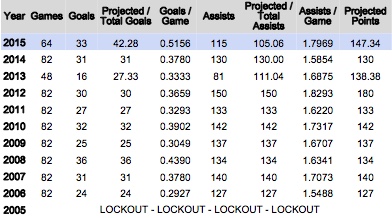
  But at 17:02, Girardi scored the 33rd goal for a Ranger defenseman this season.  The last time that the Blueshirt rearguard had that many in the regular season was the 2007-08 season (36 that year, 13 on the power play).  

  Perhaps some rephrasing would clear things up: The NY Rangers defense is on pace to score 42 goals...

  ...Notwithstanding the fact that Keith Yandle has yet to pick up a point as a Ranger.

  Let’s take a look at all of the Rangers defensive production since the 2005 NHL Lockout - We know Glen Sather has been GM since 2000, but comparing the NHL before and after the introduction of the two-line pass can get complicated.  We’ll keep it to when the Rangers were playoff-competitive under Sather, so 2005-2015.

NYR Defensive Scoring 2006-2015


Two quick points:

  1. Prior to Yandle, John Moore and Matt Hunwick had split the majority of the the season rotating in the 6th and final defensive roster spot (In fact: both were used to rearguard the 3rd pair for most the top-4’s 29 collective games injured this year). They collectively had 1 goal in 78 games before the addition of Yandle ended the John Moore experiment.  
  2. The 2011-12 Broadway blueline patrol that surprisingly picked up 180 points (30-150) in the regular season was led by the remarkably unremarkable Michael Del Zotto.  He would only last one more full, albeit lockout-shortened season before packing for Nashville in one of Sather’s slickest moves, the straight-up swap for Kevin Klein.

  The emergence of Klein has given the Rangers a journeyman who can move around the line-up, and who seems to have a knack for the big-goals lately.  The unfortunately bloated contract of Dan Boyle shouldn’t overshadow his serviceable stats - 20:03 per game, +14, 8 goals and 7 assists in only 47 games.  

  Yandle is the wildcard in this analysis.  It’s been 3 games, and all he has to show for his efforts is a -1 and 7 shots on goal.  Not terrible for a guy who has adjust to a winning mentality after 9 seasons with a struggling franchise consistently on the brink of relocating (we’d love an Anthony Duclair Seattle jersey, but that’s just us).  But the potential is insane.  On any given night, he could be the best Rangers defenseman on the team, and did we mention his cap hit is only $2.625M this year and the next?  We’ll gloss over the loss of top prospect Duclair and yet another 1st round draft pick, but can you blame us?  The Rangers “only” need to win 11 of their 18 remaining regular-season games to match their 51 win total from 2011-12.

  Need we point out NYR are 2-0-1 in the James Sheppard Keith Yandle Era? How distant the rapture of Wade Redden seems to be.

  But we have to give it up to Sather here.  Each one of the Rangers’ top six defensemen have a different background that brought them to the team:

  • Ryan McDonagh was an elite NCAA defenseman acquired in the steal of the century, eventually becoming NYR Captain.
  • Dan Girardi, originally undrafted, fought through the ranks of the ECHL & AHL to ultimately embody the 1st-pair right-hand patrol.
  • Marc Staal, 1st round pick, wasn’t even supposed to make the team in the 2007 NYR training camp, yet secured his roster position and never looked back.
  • Dan Boyle, the eldest defensive veteran, literally took an open-market paycut to come to this Cup contender last July.
  • Yandle (and Klein last year) have been important trade returns hoping to complement the present window of contention, not-so-coincidentally amplified since Alain Vigneault was hired as Head Coach.

  The current 2014-15 NY Rangers also have our vote for the strongest six ever assembled in New York by Glen Sather. And no, Don Cherry, it’s not because they’re all North American, that’s just a coincidence. The current crop of Rangers defensemen are as legitimate as a Top-6 can be in today’s NHL, and deserve all the praise and admiration they’ve collectively received, including this very article, for whatever that’s worth.