Monday, June 29, 2015

List of Unrestricted Free Agents whom are eligible for Performance Bonuses


   As we’ve written about previously, the current status of many NHL teams is that of limited maneuverability; teams like Chicago, Los Angeles & the Rangers find themselves tightly pinned against the NHL salary cap (set at $71.4 million for next season). Thus, there’s all the reason in the world to believe some teams may pursue free agency with the specific target of performance-bonus levied contracts.

  What are performance bonuses?

   Based on determined goals and accolades, a player can earn X dollars for accomplishing various objectives.

   The beauty?

   Performance bonuses are under an umbrella from any effect on a team’s cap hit… so long as a team doesn’t pay out performance bonuses that exceed 7.5% of the salary cap.

   In English?

   Any team can dole out up to $5,355,000 in performance bonuses next season without any ramification against the salary cap.

   Therefore?

   Teams like Chicago, Los Angeles & Broadway may be especially apt to seek out such contracts, in order to fill out remaining roster deficits at a maximally economic bang-for-buck.

   What’s the catch?

   There’s only 3 situations where a player can receive a contract with performance bonuses. They are…

  • If the player signing the contract is at least 35 years of age
  • If the player signing the contract is signing his 1st ever (entry-level) NHL contract
  • If the player signing the contract is an established NHL player, but is signing a contract after a significantly long absence from the league due to injury


   Look: teams don’t usually salivate when contemplating pursuit of free agents closer to age 70 than birth. However, given the aforementioned advantages of performance bonus eligible candidates, coupled with the current 2015 cap crunch league wide… this summer could be the best summer to be an elder free agent seeking employment for next season.


   In order of oldest to youngest, here’s the complete list of players (scheduled to be Unrestricted Free Agents on Wednesday July 1st) who are eligible to receive cap-friendly performance bonuses this summer:


   Let's say a team must fill its 12th, 13th, & 14th forward spots. But, the team only has $1.8 million in cap room remaining.

   Without performance bonuses?

   How does Danny Carcillo, Matt Fraser & Riley Nash... each for $600,000/year... grab you?

   Yeah... us neither.

   With performance bonuses?

   How about Brad Richards, Matt Cullen & Erik Cole? In theory this trio could be paid the same $600,000/year respectively... yet a team like the Rangers could pack a total of $3 million in easily-attainable performance bonuses into these contracts, making them more realistic an idea.

Conclusion:

   While this list doesn't exactly lend itself as a menu for a contending team's all-important puzzle piece from becoming oodles better than it already is... These skaters inherently hold an advantage against their lengthiness-in-the-tooth: all are available for cap-haven performance-bonus contracts that cap-strapped teams will likely contemplate next month.

   The NY Rangers, with only a few million in cap space to spend on a few remaining "depth" roster spots, find themselves as an ideal team to pursue at least one of these forwards.

   For better or worse.


Saturday, June 27, 2015

Digesting the Hagelin, Talbot & Raanta trades

Edit: The NY Rangers have acquired goaltender Anttii Raanta in exchange for AHL forward Ryan Haggerty. Raanta has 1 year remaining on his contract, has a 2015-16 cap hit of $750,000. Thus, the cap savings on Talbot ($1.45m) vs Raanta ($0.75m) is $700,000 for New York.

   While the exodus of Blueshirt fan-favorites Cam Talbot & Carl Haglein will leave many sad to see them go... it was the correct decision. We printed earlier that the $71.4 million salary cap likely meant the demise of Talbot & one of Hagelin or Klein... the Rangers effectively made the cut, and now appear to be smoothly cap-compliant for next October.

   Yes, they will be shoppers on the free agent market come July; but most likely, only for depth players.  

   What do the trades actually suggest? Maybe something like...


KREIDER ------------- STEPAN --------- FAST/ETEM/UFA?
ZUCCARELLO ---- BRASSARD ------ NASH
MILLER --------------- HAYES ---------- FAST/ETEM/UFA?
GLASS ---------------- MOORE ---------- FAST/ETEM/UFA?

McDONAGH ------ GIRARDI
STAAL ----------------- KLEIN
YANDLE/BOYLE/SKJEI

LUNDQVIST / RAANTA


   The Rangers are confident Jesper Fast can replace Hagelin's minutes AND his tough, tough minutes as the team's premier penalty-killing winger.

   The Rangers were less inclined to trade Klein, possibly because he played 6 or 7 shifts per game more than that of Hagelin.

   Emerson Etem, the lone contract in return, is coming off his entry-level contract after just turning 23 years of age. The new CBA dictates his minimum qualifying offer must be 105% of his previous season's actual salary, which was $810,000 (despite his AAV cap hit being $870,000). 

   Thus, Etem's minimum qualifying offer will be $850,500. 

   In contrast to Hagelin's minimum qaulifying offer of $2.4 million... Etem does NOT have arbitration rights, unlike that of Hagelin, thus the "net savings" on Etem's contract will likely be roughly $2 million less than that of Hagelin.

   Couple that exchange with Raanta, Talbot's replacement, being nearly half his predecessor's pay?

   Broadway made three economically sound moves today.

   In essence:

   Rangers traded Hagelin & a 7th Rounder for Etem, ~$2 million in cap savings, and an upgraded 2nd rounder.

   Rangers traded Talbot & Haggerty for a 2nd & 3rd Rounder, an upgraded 7th Rounder, and Antti Raanta.

   Now the Rangers have more headroom to sign restricted free agent Derek Stepan to a multi-year deal north of $6 million per year. 

   From this point in time, a 2015-16 NYR roster looks something like this: 


Or a long-term scope of today's trades could look something like this:


   In terms of last season's roles, the Rangers might be counting on '16 Fast to replace '15 Hagelin, and for '16 Etem to replace '15 Fast. 

   Remember: the Rangers stand to have anywhere from $2.5 to $4.5 million in performance bonuses to hand out this summer, so a low-cap hit signing could be bonus-heavy and thus be someone like Brad Richards.

   As for the Talbot return? 

   We speculated Talbot's perceived value being somewhere from the equivalency of a late 1st rounder to that of a 2nd rounder. It was obviously the latter, as Talbot+7th for 2nd+3rd+7th suggests Talbot treated as a premium 2nd round asset.

   Talbot worth a 2nd rounder?

   That's just what we assessed in our first Talbot offseason value article back in March.

   In any event, Sather has cut the required pesos to get his team immediately in a position to be snugly under the 2015-16 salary cap. It's always sad to see homegrown Rangers, who've performed so admirably over the years, as Hagelin & Talbot have. But the NHL is a business, Sather is a businessman, and today he did what was truly best for business.


Friday, June 26, 2015

Talbot Trade Tinkering: Final Edition


   We’ve written a lot about Rangers understudy goaltender Cam Talbot on this blog over the months. With the NHL Draft beginning tonight, and Talbot’s trade highly likely, I thought we’d submit one more piece pertinent to Talbot.

   In our March 5th article Sather’s Busy Summer, we vaguely speculated whether Talbot would be cost-cutting tradebait come the offseason.

   In our March 20th article Cam Talbot’s Value & The 2015 Goalie Market, we were the first to break down the looming probability of Talbot’s worth in a trade. It was easy to conclude that Buffalo, Calgary, Edmonton & San Jose would be the logical suitors of Talbot’s reception. 

   A week ago we listed the Top 10 (Realistic) Cam Talbot Trades during draft weekend, speculative of how valuable an asset Talbot would be to the highest bidder.

   On Wednesday we suggested Talbot’s expulsion was inevitable, as the NY Rangers will need to cut Talbot, and at least one additional Ranger, to adjust to the $71.4 million salary cap next season.

   Today I’d like to briefly suggest some alternative possibilities of return via trading Talbot. While budgetary reduction will be a paramount priority for Broadway this summer, it doesn’t completely rule out the idea of acquiring cheaply-contracted bodies in the looming Talbot deal.

   So what about a Talbot trade involving….?


Chad Johnson (Buffalo Sabres)


   Similar goalie to Talbot in the sense of contract and history as the Rangers backup. Johnson has one year remaining in his contract ($1.3 mil cap hit) before Unrestricted Free Agency in July 2016, also like Talbot. A bodily exchange of Johnson for Talbot alone would only be a net cap hit savings of $150,000 for the Rangers (they need to cut 10 times that this summer). However, if Johnson’s salary were to be retained by Buffalo, the “cap savings” for the Rangers could range from $150,000 to $800,000. Johnson has backed up 3 different NHL teams in the past 3 years (Arizona, Boston & Islanders) racking up 50 NHL games since leaving the Rangers organization in 2012. Johnson recently turned 29 years old.


   Joni Ortio (Calgary Flames)

   Calgary’s 3rd string, AHL-starting goalie, who’s been making a lot of noise about capability to transition into the big league. Ortio has played 97 AHL games with the Flames’ affiliate minor league team, and played 6 NHL games this past season. If Calgary is apt to acquire Talbot, having he and Jonas Hiller as a tandem next season… that would leave the 24-year-old Finnish goalkeeper looking for a new franchise with more opportunity. With goalie prospects Mac Skapski, Brandon Halverson & Igor Shesterkin are 3 or 4 years younger than Orito, it would give New York an immediate option to backup Lundqvist in October, while allowing the pipeline prospects to continue to develop below. Ortio's cap hit clocks in at $600,000; attractive to a team like the Rangers as it's only $25,000 above the league minimum.


 Oscar Klefbom - Edmonton Oilers


   Edmonton’s Swedish prospective defenseman whom has played 77 NHL games despite being 21 years of age. More impressively, Klefbom averaged 21 minutes per game for the dreary Oilers last season, impressing the hockey community with his tremendous upside. Klefbom is on the final year of his entry-level contract, which carries a meek $894,167 cap hit (with up to $350,000 in performance bonuses). If Broadway is looking to cut salary, and perhaps include Kevin Klein in a deal… Klefbom for Klein would save the Rangers just north of $2 million in cap savings next season. With a rich crop of budding NHL defensemen, including Martin Marincin (23) & Darnell Nurse (20)… Edmonton could be subject to unloading one of their bullion bluechips at a shot in acquiring a potential franchise goalie in Talbot.


Nail Yakupov - Edmonton Oilers


   The former #1 overall pick in 2012, Yakupov is signed for 2 more seasons at $2.5 million per season. Should the Oilers retain more than 42% of Yakupov’s salary, a straight-up swap for Talbot would be a payroll cut for the Rangers. But for more materialistic speculation, consider these subjective nuggets of thought:

  • To Rangers fans, Yakupov trade rumors have a reminiscent feel to that of a former “Glen-Sather-reclaimation-project” in that of Nik Zherdev. Yakupov has hardly smashed the league with goal-scoring since his debut (42 goals in 192 games), yet was clearly taken #1 overall for his offensive potential. Should Carl Hagelin be cut from Broadway for salary reasons, Yakupov would be a perfect fit for New York’s 3rd line.
  • Even more of an “out there” train of thought: the Rangers have not had a Russian-born NY Ranger since the days of Fedor Tyutin (who was coincidentally sent to Columbus for Zherdev). Is that relevant? Probably not. Except: If the Rangers want to woo European prospect Pavel Buchnevich to North America next season, having one of the highest-touted Russian youngsters in the lockerroom certainly couldn’t hurt. Buchnevich cited his English was extremely poor, so there’s probably not much allure to a franchise full of folks who don’t speak the language. Remember how Sergei Gonchar acted as a translator for Evgeni Malkin in his rookie year? If attempting to persuade Buchnevich to come to Rome, besides money, it could be an additional boon in having young Yakupov.

2016 Draft Picks?

   If the NY Rangers can’t get what they want in 2015 draft picks, probably due to a miscommunication of Talbot’s specific value in terms of picks… another option is acquiring 2015 picks instead. Why?

  • As we showed in our article about the historic measurements of trading draft picks, it seems teams are willing to “gamble” on picks’ particular worth when trading Year 1 pick(s) for Year 2 pick(s). Why would this happen? If two parties are at a mutual disagreement of both assigning value AND where their team will finish next season in the standings? It presents itself as a mutually amicable atmosphere for a now-for-later draft pick swap.

      If the Edmonton Oilers believe they will be a contending team in 2015-16, but don’t think Talbot is worth the #16 overall pick tonight… and simultaneously, New York believes Edmonton will flop once again next season, and believe Talbot IS worth such a pick… why not trade Talbot for Edmonton’s 2015 1st Round Pick? In this example, Edmonton would think it was giving New York a pick worse than #16, while New York thought it could very well be a BETTER pick. If two teams come to a conflicting conclusion, trading for more uncertain picks in a year can be a practical course of action.

  • Additionally, the NY Rangers could use the 2016 Draft Pick(s) acquired as an arsenal of exportable assets come the 2016 Trade Deadline. If New York finds itself in another successful season, looking to beef up for another deep playoff run, the Rangers offering draft picks to deadline sellers could be a great way of procuring reenforcement come March. 

 Conclusion

   We’ll wait and see how Talbot’s fate plays out as the draft kicks off this evening. With the NY Rangers looking to cut $1.5 to $2 million in theoretical salary cap this summer, the Talbot trade could be an indicator of future moves. Should New York liquidate Talbot for draft picks and non-NHL prospects, we see a significant portion of necessary payroll has been cut, and trimming the rest could be very minor. However, if a equal-or-greater contract is returned, it signals Sather will be inclined to make bigger moves in the coming months to ultimately get a cap-compliant roster.


   Get the popcorn out folks, its NHL Draft Weekend.

Wednesday, June 24, 2015

How The $71.4 million NHL Salary Cap Affects the NYR OffSeason


   NHL General Managers, NHL players, their agents, and the entire hockey blogosphere have learned the 2015-16 salary cap will be $71.4 million. If you’re viewing this blog, then chances are you’re at least a tad bit curious as to the obvious question: How will this affect the New York Rangers?

   The first priority remains the same as our previous weeks of articles: the Rangers must reduce their payroll this summer in order to comply by October 1st. 

    Here’s a look at the NY Rangers cap payroll for the 2015-16 season:

  • The contracts in purple indicate that player is a Restricted Free Agent this summer, and the figure in purple is the minimally realistic prediction as to what they could sign for on a 1-year deal.
  • The contracts in grey indicate that player’s contract is on the books, thus NOT a free agent.
  • The contracts in blue indicate the 2015-16 NHL minimum age as a theoretical cap hit for whatever depth players the Rangers sign this summer. In this instance, the extra skaters are all conservatively presumed to have minimum-wage ($575k/yr) deals.

   Here we see the team looks to be a few million short of being cap-compliant. And this graph represents best-case scenarios for the Restricted Free Agents re-signing at the realistically cheapest 1-year contracts.

   At best, the Rangers are a little less than $2 million over the salary cap this summer, in our extremely conservative estimations.

   So where to cut? Hmmm…

CAM TALBOT
  • Exporting Talbot in a trade, and ultimately replacing him with a lesser salary, is the easiest (and as of late, trendiest) means to reduce overall payroll.Trading Talbot away, and ultimately replacing him with that of a, say, $645,000/year goalie… would be a $800,000 reduction on the team’s books.

DEREK STEPAN


  • In a 1-year contract, we predict Stepan to sign for no less than $6 million. 
  • A multi-year contract would likely range from $6 mil to $7 mil.
  • The most similar comparable to ascertaining Stepan’s theoretical value this summer is that of Ryan O’Reilly in Colorado… O’Reilly signed a 2-year $12 million contract shortly before an arbitration hearing was scheduled.
   Our prediction for Stepan’s year-to-year rate is something like:
  • 1 years: $6.000000 / year ($06,000,000)
  • 2 years: $6.200000 / year ($12,400,000)
  • 3 years: $6.333333 / year ($17,999,999)
  • 4 years: $6.500000 / year ($26,000,000)
  • 5 years: $6.700000 / year ($33,500,000)
  • 6 years: $6.900000 / year ($41,400,000)
  • 7 years: $7.142857 / year ($49,999,999)
  • 8 years: $7.125000 / year ($57,000,000)

   Stepan is an extremely vital asset for Broadway, serving as their wonderfully productive 1st Line Center. Unless traded within the window, there’s two more seasons of Derek to play as a New York Ranger before entering Unrestricted Free Agency. 

  Sather could take the 1-year discount, delaying the probable payday contract to Stepan until next summer… although Stepan’s pricetag could easily (and likely) be higher during this time next summer. 

   Let’s hold off on figuring a course-of-action for signing Stepan until we can appreciate what assets on the team may be more expendable than the team’s #1 center. 

CARL HAGELIN

  • With Restricted Free Agency, Hagelin may be headed to NHL salary arbitration next month, if he and his team cannot hash out an amicable agreement beforehand.
  • Parallel to last summer’s arbitration decision for that of Vladimir Sobotka (in St. Louis)… we feel a 1-year $2.8 million contract is roughly what Hagelin could/should/would be awarded.
   Should the Rangers and Hagelin agree long-term? Our prediction for Hagelin’s year-to-year rate is something like:
  • 1 years: $2,800,000 / year ($02,800,000)
  • 2 years: $3,000,000 / year ($06,000,000)
  • 3 years: $3,333,333 / year ($09,999,999)
  • 4 years: $3,500,000 / year ($14,000,000)
  • 5 years: $3,600,000 / year ($18,000,000)
  • 6 years: $3,750,000 / year ($22,500,000)
  • 7 years: $3,642,857 / year ($24,499,999)
  • 8 years: $3,625,000 / year ($29,000,000)

STEPAN vs HAGELIN?

   This duo represent the the lone pair of NYR Restricted Free Agents to a) have the right of salary arbitration, b) make the most money of any of the other RFA’s, and c) be only two years removed from Unrestricted Free Agency.

WHICH DESERVES A LONG-TERM DEAL MORE?

   The answer, almost irrefutably, is Stepan. He is a #1 center, is a coveted asset to any NHL franchise. A cornerstone center, at the young age of 25, is expected to make $6 or $7 million on  a long-term contract.

   As for Hagelin? Two things to note when pondering his gravity of Broadway’s cap structure:
  • A) Hagelin is a 3rd line winger, with the upside attribute of being a phenomenal penalty killer. 
  • B) Perhaps Hagelin’s most valuable attribute to his contribution to an NHL team is his speed. Yet Hagelin, who turns 27 years old in August, will likely be losing pepper off his footwork fastball.

   In other words, what do you think is the easiest roster change to “correct or “replace” for cheaper money? A $6 million center who plays 19 minutes per game, or a $2.8 million winger who plays 15 minutes per game?

JESPER FAST (24), J.T. MILLER (23) & OSCAR LINDBERG (24)


  • All three forwards are Restricted Free Agents without the right to salary arbitration
  • We predict Miller’s 1-year extension rate is $50,000 more expensive than Fast’s, despite Miller’s minimum qualifying offer being $100,000 greater than that of Miller’s
  • Lindberg, who had a wonderful season in the American Hockey League last season, is fully expected to make the jump to the NHL next year. His qualifying offer is few thousand less than his projected 1-year minimum cost of $725,000

   With all the trade rumors surround Cam Talbot, why don’t we hear too much about any of these assets being included in a packaged trade?

   Because with the trio reasonably projected to make less than $1 million/year on respective 1-year deals… it does not seem an aspect where Broadway can be in a position to “cut the fat.” In other words, what forwards could be returned in a trade which would replace the roles of Fast/Miller/Lindberg while accounting for lesser money? 

   It seems highly unlikely.

   So…

   Let’s assume Cam Talbot is traded somewhere for draft pick(s) and/or prospect(s). And let’s also assume that the Rangers replace his role as Backup Goalie with an Unrestricted Free Agent signing this summer, of whom signs for 1-yr $575,000 (the NHL minimum wage).

   How does this change things?


   So even if all four RFA’s are signed for the most realistically stingy 1-year contracts… and even if Talbot is traded and replaced with a goalie of minimal cost… we see the team remains $275,000 over the cap.

   Not to mention, having the 21st, 22nd & 23rd roster spots all at the NHL minimum wage is a stretch for this example as well. 

   So…?

   Talbot cannot be the only Ranger to be exported this offseason. 
   
   There must be at least one other NY Ranger to be exiled, and replaced with a cheaper substitute, for the team to render itself cap compliant.

   Before we finish, let’s just remind ourselves of which NY Rangers have No-Trade and/or No-move Clauses this summer, making them the peskiest players to attempt to move?


   So while there is a lot of salary cap meat-on-the-bone with this list of NY Rangers… it would seem especially cumbersome to orchestrate a trade involving any one of them. Particularly packaging someone in a Talbot trade to either Edmonton or Buffalo, where one of these players’ approval of such a trade would seem even less likely. 

   So…

   What about the Rangers under contract with the highest cap hits whom are without any NM or NT clauses?


   What can we conclude?

   As we’ve proposed multiple times on this blog, the seemingly most “replaceable” players to dump are Carl Hagelin and/or Kevin Klein.

   Both have theoretical salary caps just south of $3 million, while their respective roles are that of 3rd line wing & 3rd pair defense. 

   McDonagh’s cap hit of $4.7 million is a bargain, considering the Captain’s role on the team.

   Stepan, Kreider & Yandle are all being paid “fairly”, given their respective roles (and Power Play capability).

   Any trade involving Kreider, McDonagh, Stepan, and/or Yandle would be as big a summer surprise as it is (at the moment) highly unlikely.


   Thus, now we see why Kevin Klein & Carl Hagelin have been the most frequent throw-in Rangers skaters mumbled amidst the weeks of Talbot trade rumors. Neither player is a toxic asset (actually both have done very well as Rangers, and would not be traded due to poor performance or sour reputation). Yet when looking for a soul to shed some salary, Hagelin & Klein are the “likeliest” suitors.

   So we will examine two different scenarios:

SCENARIO A:
  • Trade Cam Talbot & Kevin Klein for draft pick(s) and/or prospect(s)
  • Sign Derek Stepan to a long-term deal worth $6.6 mil/yr [which we predict would be a four or five year deal]
  • Sign Carl Hagelin to a 1-year, $2.8 mil deal
  • Sign J.T. Miller to a 2-year, $1.2 mil/yr deal
  • Sign Jesper Fast to a 2-year, $975k/yr deal
  • Sign Oscar Lindberg to a 2-year, $800k/yr deal
  • Sign a 7th D, such as Matt Hunwick, to a 2-year, $875k/yr deal
  • Assume Brady Skjei will be NHL-ready for duties on the Broadway’s 3rd defensive pair
  • Sign a backup goalie to a 1-year, $700k deal ($125k more than the league minimum)
  • Sign a 13th “spare” forward to 1-year, $675k deal ($100k more than the league minimum)
  • Sign a 14th “spare” forward to a 1-year, $650k deal ($75k more than the league minimum)


  • Interestingly enough, we assume if Klein is moved, that the services of Matt Hunwick (hypothetically signed for a  2-year, $875k contract) and rookie Brady Skjei will be enough “in-house” promotion to replace Klein’s role. 
  • To do this, the Rangers must accommodate a seven defensemen with only two Right-handed pointmen. If this is the case, why don’t we slide McDonagh to the right point? He played well at the 2014 Winter Olympics in the off-hand position of RD. 
  • This also frees up enough cap space to sign RFA’s Fast, Lindberg, Miller & Stepan to multi-year “bridge” deals.
  • We can also beef up the 2nd goalie, as well as 13th & 14th “spare” forwards respective cap hits, to a few notches above the league minimum.
   Scenario A brings us to a 23-man roster snugly beneath the ceiling with $50,000 in cap space.

   - Talbot is replaced by a free agent for approximately half of Talbot's 2015-16 salary
   - Klein is replaced by a combination of Skjei & Hunwick
   - Martin St. Louis is replaced by the promotion of Oscar Lindberg
   - James Sheppard & Chris Mueller are replaced by a $675k free agent & $650k free agent respectively


SCENARIO B:
  • Trade Cam Talbot & Carl Hagelin for draft pick(s) and/or prospect(s)
  • Sign Derek Stepan to a 1-year contract 
  • Sign J.T. Miller to a 2-year, $1.25 mil/yr deal
  • Sign Jesper Fast to a 2-year, $975k/yr deal
  • Sign Oscar Lindberg to a 2-year, $800k/yr deal
  • Sign a 7th defenseman to a 1-year, $800k deal
  • Sign a backup goalie to a 1-year, $725k deal ($125k more than the league minimum)
  • Sign a 13th “spare” forward to 1-year, $675k deal ($100k more than the league minimum)
  • Sign a 14th “spare” forward to a 1-year, $600k deal ($25k more than the league minimum)


   - Talbot is replaced by a free agent for approximately half of Talbot's 2015-16 salary
   - Hagelin is theoretically replaced by Fast
   - Hayes switches to wing, while his 3rd center roster spot is replaced by a $1.5 million free agent
   - Martin St. Louis is replaced by the promotion of Oscar Lindberg
   - James Sheppard & Chris Mueller are replaced by a $675k free agent & $600k free agent respectively
   - Matt Hunwick is either brought back for, or replaced by, a $800k free agent defenseman

Scenario B brings us to a 23-man roster snugly beneath the ceiling with $25,000 in cap space.

*Important Note: While the sum of $1.5 million for pursuing a 3rd line winger or defenseman seems awfully underwhelming, the NY Rangers will have as much as $2,505,000 available in performance bonuses to dish out this summer while remaining below the bonus cushion. Should the Rangers wish to "gamble," and assume Kevin Hayes will not activate his maximum potential bonus amount of $2.85 million, the Rangers could theoretically dish out $3 or $4 million in bonuses this summer and still not break the cushion. Thus, a $1.5 million 3rd line forward could actually be compensated $2.5 - $4.5 million in cap-haven performance bonuses, attracting the highest quality of forwards willing to sign on for a 3rd line role.

Conclusion

   These two scenarios seem to be the likeliest ones for a vague picture of the Rangers' team come October. Neither involve trades which tinker with the nucleus of role players pivotal to the team's chances at a Stanley Cup. Simply put: Hagelin, Klein & Talbot will be missed, but not irreplaceably so. 

   There's no reason to think a trade involving Lundqvist, Nash, McDonagh, Staal or Girardi will take place this summer. If not for the unlikely possibility of any of these players waiving there NMC/NTC's, the simple fact that Scenarios A & B demonstrate there should be ZERO pressure at all for Glen Sather to make such a deal.

   Yes, the Rangers need to cut salary. Aptly put, the roster will require metaphorical off-season surgery. Yet while the deportation and replacement of Hagelin, Klein and/or Talbot represent minor surgeries like wisdom teeth removal or laser-eye... why in the world would Broadway go a few steps further and voluntarily engage in open-heart surgery by way of dealing Lundqvist, Nash, Stepan, McDonagh, Staal or Girardi?

   This is not a team looking to make huge adjustments after a largely disappointing 2014-15 season. The team won the President's Trophy, was a viable threat until the end, and was 20 minutes away from their 2nd consecutive Stanley Cup Final. Unlike teams like Colorado, Dallas or Toronto... this is not a team with political carte blanche to rewire all aspects of the roster.

 This is a team that should be considerably more apt to trim around the edges than rebuild its central configuration.

   It doesn't make much sense for the Rangers to move the big pieces... at least not quite yet.


Sunday, June 21, 2015

Battle of the Hudson: Rangers vs Devils in NHL Drafting

Glen vs. Lou
Comparing Draft History from 2000-2011


With the upcoming 2015 Entry-Draft less than a week away, and with rumors that Glen Sather may be leaving the New York Rangers soon, we thought we’d take a look at Sather’s drafting history with the club.  Since 2000, Glen has been at the helm, finding gems in later rounds (Henrik Lundqvist comes to mind) while often choosing poorly in the earlier ones (Cam Fowler comes to mind…).  There have been periods where it seems like the Rangers have gone ages without a solid draft pickup, and there have been years where you have to scratch your head in amazement as the team stocks up on sneaky-good talent.  

This year, the Rangers currently hold five draft picks, none earlier than their 2nd Round, 59th overall.  Though this is one of the latest first picks the Rangers have had in the last 15 years, Sather has certainly grown accustomed to not picking early.  From 2000-2014, the Rangers have averaged the a bit later than the 26th pick overall as their first selection in a given draft.  Much of this has to do with the Rangers recent success, as they have made the playoffs in 9 of the last 10 seasons, thus ensuring their pick was no higher than 15th in the ensuing drafts.  Sather has also made a habit of trading his first round pick in recent seasons, and to varying degrees of success.


The Rangers’ cross-river rival, the New Jersey Devils, have a similar drafting history to the Rangers since 2000.  Lou may be gone, but with these teams going head-to-head for so many years, we thought we would ask the following question: Does Glen Sather or Lou Lamoriello draft better?


MATCHUP 1: TOP PICKS BY YEAR


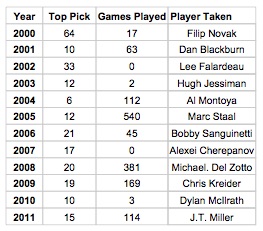
So let’s look at the numbers.  First, we should take a look at each team’s first pick from 2000-2011.  We did not include the picks from 2012-14, as they are still in development.  We also focused on games played, as it is a quality-metric that all three positions share.  How did Glen do?


Glen Sather Drafting History - Sheet1.jpg


Let’s look at the positives first.  Marc Staal is a “franchise” defenseman, Chris Kreider looks like he is turning into a solid power-forward, and J.T. Miller is finally showing the consistency that has been sorely missing from his game.  Those three draft picks alone make up an important chunk of the current roster.  Michael Del Zotto was certainly not a bust in his rookie campaign (37 points in 80 games, including 22 power play points).


Now let’s get to the brutal side of Sather’s drafting career.  Hugh Jessiman’s name was burned into the heart of Rangers fans in a deep 2003 draft, and as we watch Ryan Getzlaf and Zach Parise succeed (they were available for the Rangers to take), we won’t be forgetting anytime soon.  Everybody knew the Rangers were going to draft Cam Fowler in 2010, and yet they took the enforcer-style Dylan McIlrath who seems to always be just outside the Rangers depth chart.  Bobby Sanguinetti managed to get in a whopping 5 games with the Rangers before his career bounced between the AHL, NHL, and KHL.  Last year, he was the top scoring defenseman for the Utica Comets, the AHL affiliate of the Vancouver Canucks.  Not bad for an average hockey player, but not what the Rangers were hoping for.


In fairness to Sather, we must mention that Dan Blackburn sustained a freak shoulder injury that forced him to retire in 2005 at the age of 22.  And of course, the highly touted Alexei Cherepanov never made it to New York, as he shocked hockey fans everywhere, passing away during a KHL game. Hard to fault Sather for these unfortunate events.


For context, let’s take a look at how Lou Lamoriello did over that same period.  From 2000-2014, the Devils have drafted 29th overall on average.  This is just a bit behind the Rangers overall draft position during the same period.  How did Lou do?


Compared to the Rangers, the Devils actually have drafted fairly well with their first pick.  Their best pick is clearly Parise.  Their worst pick is a bit harder to discern.  Adrian Foster never played in an NHL game, but he was taken 28th overall, not 12th like Jessiman.  It is notable that the Devils have not drafted anyone who has played over 200 games since 2005, and that dearth in depth has really started to manifest itself on their roster.  But there is no denying that the Devils struck gold with Parise, and to a much lesser extent, Travis Zajac.  I imagine most Rangers fans would rather have drafted Parise than Staal, but then again, it’s easier to be allured by points than by stout defense.  


ADVANTAGE: It’s close, but Lou Lamoriello


MATCHUP 2: ALL DRAFTING BY YEAR


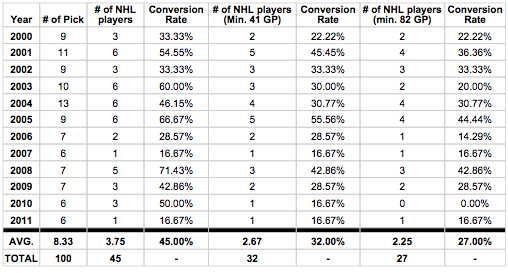
To get a fuller picture, let’s see how the Rangers have done overall under Glen Sather’s leadership.  We took a look at all of the Rangers picks from 2000-2011, and determined what percentage of those picks turned into NHL players.  We broke it down into three groups:  Players who have played a single NHL game, players who have played at least 41 games in their career, and players who have played at least 82 games, or a full season’s worth of games, in their career.  Here are the results:

New York Rangers Drafting 2000-2011
Sather - Conversion Rates.jpg


Overall, the Rangers have drafted a sizable number of players who have put on an NHL jersey at least once in their career.  45% of their draft picks have played at least one game at the NHL level.  When you remove the players who have played less than a full season, that percentage becomes 27%, and this is what we would expect to see.  Many players never make it out of the AHL, and many times those that do only get a whiff at a game or two in the top league.  There just aren’t enough available slots in the roster for every draft pick to make it.

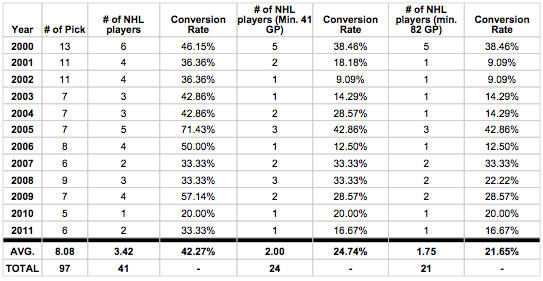
Let’s contextualize this.  How have the Devils done in comparison?  Their drafting chart is below:

New Jersey Devils Drafting 2000-2011
Glen Sather Drafting History - Devils History.jpg


The Devils have drafted only three fewer player than the Rangers over this time-frame, but their overall yield is lower than the Rangers.  Over 42% of the Devils picks have played at least an NHL game, and yet when we compare the number of players who have played a full season or more of games, the difference becomes much more stark.  NHL-ready players have so much more value than a player who has never played a game at the highest level.  These players can help your team in the short term, or be flipped for better players in the long-term.  Sather has had more flexibility at recent trade deadlines because the Rangers suddenly have a solid pool of talent.  The Devils, on the other hand, remained in the Eastern Conference basement as their overall team depth is lacking.  


ADVANTAGE: It’s close, but Glen Sather


MATCHUP 3: CURRENT HOMEGROWN ROSTER


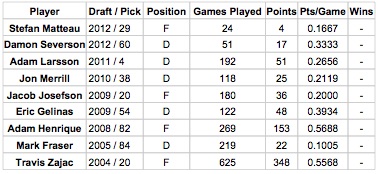
Finally, let’s compare each team’s draft picks from 2000-2011 that ended last season on their respective rosters.  Let’s mix it up, and take a look at the Devils’ current home-grown group:
Glen Sather Drafting History - Best Rangers.jpg
These nine players have combined for 1,800 games in their career.  That averages out to 200 games per player.  It’s an interesting cast of characters, but only three of them have more than 192 games of NHL experience.  There is also not a forward who stands out as “elite”. Adam Henrique has been solid so far, but Travis Zajac is not anyone’s idea of a first-line center, and Jacob Josefson has failed to live up to expectations (11 points in 62 games in his fifth year).


What about the current crop of homegrown New York talent?  There’s a lot to love here:


Glen Sather Drafting History - Best Devils.jpg


Right off the bat, we have 8 players who were integral to the Ranger’s success last year.  To compare with the Rangers, these eight players have amassed 2,825 games collectively.  That’s 353 games per player on average!  And you want to talk about “elite”?  Derek Stepan is an all-situations top-flight center, Marc Staal has proven his penchant for shutting down opposing top lines night-after-night, and Henrik Lundqvist is, well, Henrik Lundqvist.


ADVANTAGE: At the moment, Glen Sather


Time will tell for many of the players already drafted by both teams, with Anthony Duclair (since deported to Arizona) and Pavel Buchnevich headlining the Rangers recent draft picks.  But at least we can say, relative to Lou and the Devils, if Glen isn’t ahead of his contemporary, he’s certainly not far behind.