Friday, March 20, 2015

Cam Talbot's Trade Value & The 2015 Goalie Market


 Why are people talking about trading Cam Talbot in the summer?


   The more impressive Talbot plays as the NY Ranger’s acting starter goalie since Henrik Lundqvist’s injury, the higher is trade value is. If a rival NHL team is looking for goaltending, the more Talbot makes a case as a legitimate NHL goalie, the more that team would be willing to give New York in a trade. With no disrespect to Talbot, nor denial of his exquisite play over the last several weeks... trading Talbot in the summer remains a very logical possibility.


   Is there a goalie controversy in New York?

   No. There is not. Talbot has had a spectacular career since breaking into the league, and has successfully performed when asked to be a starter. But Lundqvist is on the first year of a massive $8.5 million per year contract, and will not be “dethroned” by anybody anytime soon. This is another reason why Talbot June trade rumors have already become speculative here in March.


   What is Talbot’s trade value?

   It’s tough to say or measure what NYR could get for Talbot in a trade. There are a number of factors to consider when evaluating a goalie’s trade value in the off-season.

   What factors are there to consider?

      For starters:
  • How many goaltending spots/games are up-for-grabs in 2015-16?
  • How many goaltenders will be in the 2015 unrestricted free agent pool?
  • How convinced will rival General Managers be in Talbot as a (potential) franchise asset?

   How many goaltending spots are currently up for grabs in 2015-16?

   Looking over the contracts of the other 29 NHL teams, we’d predict at least 7-11 goaltending spots currently available for next season…
   - Buffalo & San Jose could be the biggest shoppers should Anders Lindback and/or Antti Niemi walk unrestricted when their contracts expire in July. Both teams have historic backups contracted 1 more year (BUF- Chad Johnson, SJS- Matt Stalock). Each franchise could be looking for 50-70 games of goaltending to fill.
   - Edmonton, with Viktor Fasth becoming an UFA, and Ben Scrivens only under contract 1 more year, could field suitors to play anywhere from 30-60 games go goaltending to fill.
  • Arizona, Calgary, Columbus, Dallas, NY Islanders, Philadelphia & Pittsburgh could also be looking for (back-up) goaltending this off-season:
   Why is it 7-11 spots “at least?”

   Looking over incoming contract gaps isn’t everything to consider. There are some goalies who are currently set to be under contract in 2015-16, but could be bought out or buried in the minors in the next 6 months.

   What goalies are the likeliest to get buried or bought out in the off-season?

  • Ondrej Pavelec, Winnipeg Jets: With his below-average play, and rookie phenom Michael Hutchinson emerging as the franchise’s top-dog… The final 2 years of Pavelec’s deal could logically be bought out in June. With Winnipeg among the lowest-payroll clubs in the NHL, Talbot’s $1.45 million + Hutchinson’s $0.575 million could/would be the best bang-for-buck duo of netminding in quite some time.

  • Niklas Backstrom, Minnesota Wild: Similar to the above, Backstrom has 1 year left on his contract and has not put up quality numbers. Minnesota, whom has youngster Darcy Kuempfer under contract, is also set to lose Devon Dubynk & Josh Harding to free agency. Nobody would be surprised at a Backstroke buyout.

  • Cam Ward, Carolina Hurricanes: Notice the pattern? Relatively high cap hit on the final year of a hefty contract, coupled with below-average goaltending numbers in 2014-15, Ward is also a strong candidate to be bought out. It’s highly conceivable Carolina would free up room with a buyout to shop the market for someone to split time with Antoine Khudobin. 

  • Mike Smith, Arizona Coyotes: While a 2015 buyout of Smith seems unlikely despite his disappointing 2014-15 campaign, Arizona will likely seek a back-up. If Arizona is open to the possibility of seeking a new starter in lieu of Talbot... a feasible course of action could be to acquire Talbot, and buyout Smith in 2016 before offering Talbot a new contract extension. Smith is under contract until 2019. 

  • James Reimer, Toronto Maple Leafs: Should Toronto seek to couple Jonathan Bernier with a different goalie capable of playing 25-45 games other than Reimer, unless traded, could be bought out of his final contract year. Toronto will be under enormous pressure to improve this off-season, and made the slick salary cap trade of David Clarkson-for-Nathan Horton, to free up millions of dollars in theoretical spending (should Horton remain on Long Term IR as expected). 


* = Restricted Free Agent on July 1st, 2015


   That's great... So what is Talbot’s trade value?

   We know there’s 7-11 goalie spots, with perhaps more should buyouts or AHL-burials come about. There’s only 2 or 3 bonafide #1 goaltending spots, with the rest being back-ups or fifty-fifty splitters. 

   The other side of the coin is: what is Talbot’s competition in filling these 2015-16 open spots? 

   List of Top-15 outgoing Unrestricted Free Agent goaltenders with expiring contracts on July 1, 2015:

  • D. Dubynk
  • A. Niemi
  • V. Fasth
  • A. Hammond
  • M. Neuvirth
  • K. Ramo
  • J. Gustavsson
  • J. Enroth
  • A. Lindback
  • R. Emery
  • T. Greiss
  • D. Ellis
  • C. McElhinney
  • J. Harding
  • R. Bachman

   List of current 2nd/3rd string goalies under contract who could be traded to other teams as a 1st/2nd string goalie?

  • BOS: N. Svedberg / M. Subban
  • CHI: S. Darling / A. Raanta
  • COL: R. Berra / C. Pickard
  • TBL: A. Vasilevski / K. Gudlevskis
  • WSH: J. Peters / P. Grubauer 

   So there are a lot of goalies out there to fill the 7-15 goalie spots available for next season. Again, what is Talbot’s trade value?

  • A recent comparable to a goalie (similar to Talbot) being traded straight up for value was Corey Schneider in June 2013. At the time of his trade, Schneider had similar characteristics as Talbot does now (age, statistics, similar risk with investing in goalie as franchise starter). However... Talbot will have only played roughly half the NHL minutes as Schneider, making his sample size less, thus less proof that Talbot could be a legitimate big-minute NHL goalie. Schneider had more than triple Talbot’s ’15-’16 cap hit, but double the years under contract at the time of his trade.

      The Vancouver Canucks traded Schneider’s remaining contract year before unrestricted free agency to the New Jersey Devils on June 30th, 2013 for the 1st Round (9th overall) pick of the ’13 draft.


  • The last time the NY Rangers traded a player with similar contract stature for a lone draft pick? When they traded Derek Dorsett to the Vancouver Canucks on June 27th, 2014 for their  3rd Round (85th overall) draft pick in the ’14 draft.
  Conclusion:

   If Schneider fetched a 1st round & Dorsett fetched a 3rd round, it wouldn’t be the wildest thought in the world to figure Cam Talbot’s trade value as something around a 2nd Round draft pick in the '15 draft. Talbot’s NHL career has less sample size than Schneider’s, but would certainly fetch more than Dorsett in terms of potential value to a franchise. 

  • We predict that, alone, Talbot could be traded for a 2nd round pick in the off-season
  • If an NHL club is really looking to upgrade goaltending, look for investment over the next stretch of seasons, NYR could probably throw in goaltending prospects Mackenzie Skapski, Brandon Halverson, or Igor Shestyorkin with Talbot for a 1st Round pick. Halverson & Shestyorkin both played in the latest World Juniors tournament, and Skapski recently became the lowest-drafted NHL goalie in history to record a shutout at age 20. 

   With the franchise contract protecting franchise goalie Henrik Lundqvist, coupled with New York’s strong crop of young up-and-coming goalies, it would make a lot of sense to deal Talbot and 1 or 2 prospects to teams willing to pay quality draft picks. Draft picks acquired in the summer can always be used as trade chips for the following trade deadline, especially when it comes to NHL clubs more designed to win games in the present than down the road. 

   If the NHL salary cap only increases a few million dollars in 2015-16, as suggested by the most recent reports, then the potentially cap-strapped Rangers could logically shave up to $875,000 by trading Talbot and signing a minimum-wage free agent replacement. We shouldn’t count on Skapski stepping in as a full-time 2nd string in 2015-16 as he is early on in his professional career and will likely be the AHL affiliate Hartford Wolf Pack’s starter, getting regularly tough playing time. 

Cam Talbot's last 10 games

   And while NYR General Manager Glen Sather has made some awful signings in New York, all 3 of his Cam Talbot signings have been significantly great value. If Talbot is indeed traded for a 2nd round draft pick, it will be a total gain for the franchise. Talbot was initially signed out of the NCAA (University of Alabama) after being undrafted. It was for the NHL minimum wage. Before playing his 1st NHL game, before Martin Biron's suddent retirement in 2013... Talbot was re-signed for a 1-year extension at the same cap hit as his initial contract. And earlier this year, well before Lundqvist's strained neck blood vessel injury, Talbot was signed to another 1-year extension, this time $1.45 million. 

  Of course there's still the chance he is not traded, and kept for the 2015-16 NYR campaign. If not sought to be a starter elsewhere, while in NY Talbot has demonstrated to be perhaps the premier NHL backup goaltender in the league.

   In summer of 2009, the NY Rangers traded a 5th round pick to Pittsburgh Penguins for NCAA (University of Alaska) goalie 23-year-old Chad Johnson. Safe to say, if traded, Cam Talbot would fetch more than that.


Thursday, March 12, 2015

NY Rangers Continue Elite Hockey, Kevin Klein Gets X-Rayed

   Following the NY Rangers defeat of division rival Washington Capitals last night, the NY Rangers have moved into #1 in the NHL (with games at hand over everyone, mind you), causing the NYR fan online-community to drop some pretty absurd statistics in the hours following the game. Here are a few...

PROJECTED NHL STANDINGS POINTS OVER 82-GAMES:
via HockeyRodent.com


   But on a less joyful subject...

   In the final minute of the New York Rangers' 3-1 defeat of the Washington Capitals, Kevin Klein took a puck to the arm/shoulder and painfully made his way off the ice. Andrew Gross reported Klein, sporting bandages over his arm, when asked "Are you OK?', told reporters "No, not really." K.K. will have X-Rays taken, which is certainly not a good sign for Rangers fans. We here at SatherOnWaivers don't have any additional information to add to this story, but we can offer some analysis into the worst-case scenario:

   In January 2013, Joffrey Lupul took a puck to the arm (video HERE), and ended up missing the next 52 days nursing a broken arm. If, hypothetically, Klein did suffer a broken bone last night, and such a timetable of recovery was given here: Klein would theoretically return the 1st week of May, likely the 2nd round of NHL playoffs. 

   While both Lupul & Klein's injuries appear similar to one another, it's not yet known whether or not the diagnosis will be comparable at all. In the mean time, Matt Hunwick, Chris Summers & Mike Kostka are the "spare" defensemen the NY Rangers have available in the event Klein misses serious time.

   Editor's Note:

   Sounds as if Kevin Klein will miss time, likely a broken arm, could be 4-6 weeks. NHL Playoffs begin in 5.


Tuesday, March 10, 2015

A Tale of Two Talbots - Cam's Fattest Rebound


Cam-Talbot_Henrik-Lundqvist.jpg


It’s now been 17 dark, empty games since Henrik Lundqvist went down with the injury that would stress-test the Rangers goaltending depth for the first time since 2006.


Okay, it hasn’t been that bad without the most consistent goaltender of the last decade.  You’ve surely noticed the Rangers haven’t lost a step in the standings, and are now on pace to finish first in the NHL (check out the table in the right margin, as well as the quality writing elsewhere on Hockey Rodent).


So how have the Rangers managed to stay afloat without their all-world goaltender?


This is the tale of two Talbots.


It wasn’t long ago that the Rangers signed Cam Talbot to his first contract extension, a 1-year $1.45M pact that seemed part “thank you” and part “but you haven’t proved anything yet”.  He  played well in relief of Lundqvist in 2013-14, and stood out when Lundqvist’s contract extension was impacting the King’s game (not a proven theory, but it sure did seem like it).  The fact that Talbot even made the team last season was remarkable on its own.  Nobody saw the sudden retirement of Martin Biron coming, especially not in the first few weeks of the season.  Talbot moved into the backup role and finished the season with a .941 SV% and 1.61 GAA in 19 starts - more than you could ask for from your second in command in his first season.


So when the Lundqvist injury shocked the hockey world, Talbot was thrust into yet another opportunity.  Let’s take a look at his first 8 games since the Rangers sidelined Lundqvist.


Yikes! These are uncharacteristically bad numbers, even if he did pick up five wins.  Also, five of these games were on the road, but three of those games came against non-playoff teams.  There’s no denying how fun these games were to watch, but Rangers management may not have enjoyed the constant lead-changes and puck-handling gaffes that were becoming almost habitual.  And then the rumors started.


The Rangers had been linked to Antoine Vermette for months leading up to the trade deadline, as the center position was believed to be the weakest part of their roster.  With Talbot struggling, the focus shifted to possibly acquiring a veteran goaltender to lighten the load until Lundqvist returned.  An addition like this could handcuff the cap-crunched Rangers heading into the deadline.

Alain Vigneault saw an opportunity to give Talbot some rest (remember, this is the first time Talbot’s been a “number one” goalie in a couple of years), and Mackenzie Skapski was given his first NHL start against Buffalo, winning 3-1 after allowing a goal in the first 14 seconds of the game.  Since that game, Vigneault has handed the reigns to Talbot, and here’s what he has to show for it.


His numbers are... ridiculous.  It’s hard to say which statistic is the most impressive, but being named 3rd star of the week by the NHL is certainly on the list, an honor bestowed on Lundqvist only four times in his career.  If you pull out just his March numbers, it’s even more impressive:


Talbot has started off the month by facing four of the League’s top teams, and scooping up 7 out of 8 possible points.  We’ll let his individual numbers speak for themselves, though we can’t leave out that his shutout of the Blackhawks was the first by a Rangers goalie since 1969.

--------------------

Henrik Lundqvist is still the undisputed leader of this team, and 17 games isn’t going to change that, at least not this season.  Nobody should doubt that Talbot will be second-banana in April, but he does give the Rangers something that a playoff team never realizes it needs until it doesn’t have it: a solid backup goalie.  

Just ask Montreal...

And thinking a bit longer down the road, his $1.425M cap hit is sure looking pretty cheap right now, don’t you think?  I wonder what he’d fetch on the trade market...

Monday, March 9, 2015

Examining The 2015 NY Rangers Blueline

Is this the best offensive defense that Glen Sather has Ever Assembled?

  At 17:02 in the first period, Dan Girardi picked up his 3rd goal of the season against a very good Detroit Red Wing penalty kill.  On its’ own, this isn’t article-worthy news.  Girardi’s points-per-game numbers look ordinary to those of his career, as do Ryan McDonagh’s and Marc Staal’s.  

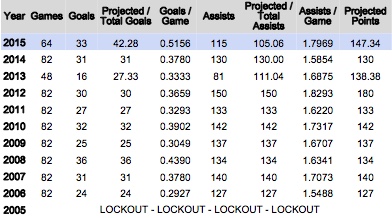
  But at 17:02, Girardi scored the 33rd goal for a Ranger defenseman this season.  The last time that the Blueshirt rearguard had that many in the regular season was the 2007-08 season (36 that year, 13 on the power play).  

  Perhaps some rephrasing would clear things up: The NY Rangers defense is on pace to score 42 goals...

  ...Notwithstanding the fact that Keith Yandle has yet to pick up a point as a Ranger.

  Let’s take a look at all of the Rangers defensive production since the 2005 NHL Lockout - We know Glen Sather has been GM since 2000, but comparing the NHL before and after the introduction of the two-line pass can get complicated.  We’ll keep it to when the Rangers were playoff-competitive under Sather, so 2005-2015.

NYR Defensive Scoring 2006-2015


Two quick points:

  1. Prior to Yandle, John Moore and Matt Hunwick had split the majority of the the season rotating in the 6th and final defensive roster spot (In fact: both were used to rearguard the 3rd pair for most the top-4’s 29 collective games injured this year). They collectively had 1 goal in 78 games before the addition of Yandle ended the John Moore experiment.  
  2. The 2011-12 Broadway blueline patrol that surprisingly picked up 180 points (30-150) in the regular season was led by the remarkably unremarkable Michael Del Zotto.  He would only last one more full, albeit lockout-shortened season before packing for Nashville in one of Sather’s slickest moves, the straight-up swap for Kevin Klein.

  The emergence of Klein has given the Rangers a journeyman who can move around the line-up, and who seems to have a knack for the big-goals lately.  The unfortunately bloated contract of Dan Boyle shouldn’t overshadow his serviceable stats - 20:03 per game, +14, 8 goals and 7 assists in only 47 games.  

  Yandle is the wildcard in this analysis.  It’s been 3 games, and all he has to show for his efforts is a -1 and 7 shots on goal.  Not terrible for a guy who has adjust to a winning mentality after 9 seasons with a struggling franchise consistently on the brink of relocating (we’d love an Anthony Duclair Seattle jersey, but that’s just us).  But the potential is insane.  On any given night, he could be the best Rangers defenseman on the team, and did we mention his cap hit is only $2.625M this year and the next?  We’ll gloss over the loss of top prospect Duclair and yet another 1st round draft pick, but can you blame us?  The Rangers “only” need to win 11 of their 18 remaining regular-season games to match their 51 win total from 2011-12.

  Need we point out NYR are 2-0-1 in the James Sheppard Keith Yandle Era? How distant the rapture of Wade Redden seems to be.

  But we have to give it up to Sather here.  Each one of the Rangers’ top six defensemen have a different background that brought them to the team:

  • Ryan McDonagh was an elite NCAA defenseman acquired in the steal of the century, eventually becoming NYR Captain.
  • Dan Girardi, originally undrafted, fought through the ranks of the ECHL & AHL to ultimately embody the 1st-pair right-hand patrol.
  • Marc Staal, 1st round pick, wasn’t even supposed to make the team in the 2007 NYR training camp, yet secured his roster position and never looked back.
  • Dan Boyle, the eldest defensive veteran, literally took an open-market paycut to come to this Cup contender last July.
  • Yandle (and Klein last year) have been important trade returns hoping to complement the present window of contention, not-so-coincidentally amplified since Alain Vigneault was hired as Head Coach.

  The current 2014-15 NY Rangers also have our vote for the strongest six ever assembled in New York by Glen Sather. And no, Don Cherry, it’s not because they’re all North American, that’s just a coincidence. The current crop of Rangers defensemen are as legitimate as a Top-6 can be in today’s NHL, and deserve all the praise and admiration they’ve collectively received, including this very article, for whatever that’s worth.

Sunday, March 8, 2015

Talbot vs Lundqvist? Introducing "The Ludas Rating", a BRAND NEW goaltending stat!

   Is it a bigger accomplishment to receive a (C+) in a very, very difficult class in school... or receive an (A-) in a trivially easier one? 

   In an effort to run some numbers on NYR goaltenders Henrik Lundqvist & Cam Talbot, we here at SatherOnWaivers have accidentally stumbled upon a whole new method of analyzing & evaluating an NHL goaltender’s performance in a season. Initially we wanted to judge Talbot’s performance in net this season versus Lundqvist, particularly this season since filling in full-time for Lundqvist since his injury. So here’s what we did:

  • We went through each net minder’s seasonal game log, and noted the amount of ice time each goaltender logged against each NHL team.
  • Then, we calculated each goalie's respective opponent’s # of NHL standings points, weighted in average of each goalie's specific icetimes against each opponent
  • In the name of relativity and perspective, we also found the same data for both goalies in the 2013-14 NHL season as well
  • Finally, we procured a weighted average of how many standings points in an opponent each goalie was facing in the average-60 minute game.

   Still confused?

   Let’s say it’s the 2013-14 NHL Season, we want to compare a few goalies, and the NHL league-wide average standings points per team was 92.233. Goalie A played 60 minutes against the Buffalo Sabres, who were the worst team in the NHL (52 points). Let’s say in those 60 minutes, Goalie A had a GSAA of 3.00, meaning he theoretically stopped 3 more goals than the baseline-average NHL goalie would have stopped himself. Now Goalie B, on the other hand, also played 60 minutes that season, except played the Anaheim Ducks, who were the #1 team in the West (116 points). Yet in that game, Goalie B had a GSAA of 1.50.

   Goalie A stopped 3 goals-above-average against a terrible team, while Goalie B stopped 1.5 goals-above-average against an elite team. So which performance was empirically better?

   That was what we were trying to offer a remedy to, but instead created a brand new goaltending analytic: The Ludas Rating. The Ludas Rating offers itself as a measure of inflation/deflation for performance numbers, taking into account what quality of opponent those numbers were generated from in the first place. 

   In other words, the Ludas Rating attempts to tackle  “how many standings points was Hank or Cam facing in the average game? … And even then, how does one compare different performances against varying quality of opponent?”

   To solve this example...

   Goalie A: 
  • 3.0 GSAA in 60 minutes
  • Average NHL Standings points of Average Competition: 52
  • Average NHL Standings points per NHL team: 92.233

52 / 92.233 = 0.5638

3.00 x 0.5638 = 1.691

1.691 “adjusted" GSAA per hour, or a “Ludas Rating” of 1.691

   Goalie B:
  • 1.5 GSAA in 60 minutes
  • Average NHL standings points of Average Competition: 116
  • Average NHL Standings points per NHL team: 92.233

116/92.233 = 1.2577

1.50 x 1.2577 = 1.8865

1.8865 “adjusted” GSAA per hour, or a “Ludas Rating of 1.8865

   … So it would seem Goalie B has a higher/better Ludas Rating, as his traditional numbers were not as good as those of Goalie A, but his quality of competition was much higher, thus making his 1.5 GSAA/hr vs ANH adjustably better than the 3.00 GSAA/hr vs BUF. 

   So now that we’ve explained what the Ludas Rating is, let’s return to the original subjects of Cam Talbot & Henrik Lundqvist. Here’s their relative stats from last year, the 2013-14 NHL season:


   And just like the introductory example into the Ludas Rating, we see Talbot’s .7558 GSAA/hr seems vastly superior to Lundqvist’s .1963. But, taking into account Talbot was playing weaker competition (83.536 standings points/opponent) than Lundqvist (91.716 standings points/opponent), the Ludas Rating adjusts Talbot’s GSAA/hr to be a lower rate. While Lundqvist technically has his lowered too (playing opponents less than 1% below-average), not nearly as much as Talbot’s. 

   Like other analytical metrics into interpreting data, the Ludas Rating is not perfect. A franchise playing against Lundqvist in October may be a very different team than the NHL Standings will reflect 6 months later. Goalies must face 328 shots in an 82-game season to qualify, as their GSAA is not tabulated under a lesser sample size. This is a quality-of-competition adjustor for GSAA-per-hour, using relative NHL Standings Points as a measuring stick to judge opposition’s “quality.” 

   So what about their Ludas Ratings in the current 2014-15 NHL season?

   *Since the season is ongoing, and teams have not completed all their games, the metric of figuring the Average NHL Standings Points per Team is “projected”, unlike prior seasons fully in the books. That is to say, if a team has 60 Standings Points in 60 games so far, they will be treated as though they are an 82-Standings Points team as that is their current mathematical projection. 


   Once again we see Cam Talbot has faced overall-lower competition (avg 88.9 standings points per opponent) than King Henrik (avg 94.668 standings points per opponent). 

   In both seasons, the Ludas Rating has reduced Talbot’s impressive numbers to a more realistic amount, as he has not been facing quality competition. Yet it is worth reminding: Talbot, an undrafted net minder who played college hockey at University of Alabama-Huntsville, who stumbled into the NHL following an abrupt mid-season retirement from Martin Biron in 2013… has undeniably played above-average in his time in New York.

   Are we expecting Talbot to play as good, or better than, Lundqvist? Probably not. Are we expecting Talbot to play above-average in the NHL? Of course. These studies show that, while his sharp career numbers are impressive, a little zip comes off the fastball when we hold Talbot accountable for playing sub-average teams for the most part. Overall, it’s hard to truly feel Cam Talbot is not performing satisfactorily... just not as well as Lundqvist.

* Please note: The data required to calculate a goaltender's Ludas Rating is very obnoxious and tedious. We are working on an algorithm to run smooth tabulations of various goaltenders' Ludas Rating, as to expand upon the metric, and provide more relative insight into goaltending leaguewide and in seasons past. We will post new data as it comes in, we ask you to be patient as this is a new equation, and currently takes a long time to configure. We look forward to your feedback!


Saturday, March 7, 2015

2 Quick Graphs: Stanley Cup Trends & How Good Is Henrik Lundqvist's Career?


   Last week, SatherOnWaivers wrote a piece about recent Stanley Cup winning teams having varying Faceoff % & Powerplay %. We thought we’d dig around a bit more, and so we graphed some stats of the past 6 Stanley Cup champions’ performances in respective playoffs (These stats are calculated per minute of given postseason, not counting minutes when team did not have a goalie in the net).

   Here they are:

Trend of "Real-Time" team statistics for past 6 Stanley Cup Champions


Observations?

  • Blocked Shots is the only stat consistently trending down, none of the stats consistently trend up.
  • “Hits” and “Takeaways” seem to be negatively inverse, as one will decrease as one increases, and vice versa.
  • “Hits” and “Giveaways” seem to be inversely mirroring one another, both rising and dipping similarly.

  • Last season, the LAK had the highest rate of Hits, Faceoff Wins, & Giveaways of any Championship postseason since 2009. However, they also had the lowest rates of Blocked Shots and Takeaways.
*     *     *     *     *     *     *     *     *


   Henrik Lundqvist had the most Vezina voting in his 1st, 7th, or 8th full NHL season than either 3 Hall-of-Famer goalies. In fact, his 2012 Vezina Award was won at 80% (four-fifths of all votes), making it the most lopsided Vezina vote in NHL history!

   Of all the top NHL goaltenders to play since the 2004-05 lockout, Lundqvist stands out in terms of consistency & quality. Unlike Luongo, Rinne, Miller, Quick, Fleury or Price... Lundqvist has yet to have a below-average NHL season compared to league-average statistics.


Thursday, March 5, 2015

Sather's Busy Summer - Part 1

Let’s pretend the salary cap doesn’t go up in 2016...

Since the NHL adopted a salary cap in 2005-06, growth has been an assumption for teams trying to plan out the future of their franchise.  The growth of a key player can be the m issing link that separates an elite roster from a middling team clinging to a playoff spot.  The growth of a fanbase can drive the success of a team, as increased ticket sales and TV deals lead to an uptick in spending to the cap.  But one factor that rarely changes is the expectation of an increased salary cap.  Unless Gary Bettman allows teams to amnesty more bloated contracts, this may be the year where cap-crunched teams are forced into decisions they would otherwise never make.

There are various factors (a weak Canadian dollar, contracted players voting in favor of not raising the cap) that contribute to the uncertainty surrounding this offseason for every team in the NHL.  This isn’t an article about why the cap may stay flat, but rather what that would mean for the New York Rangers.


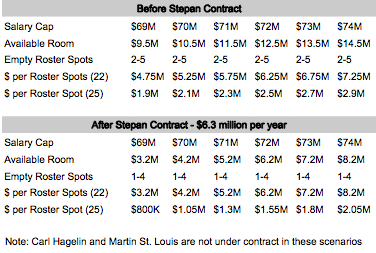
The Rangers have a handful of cap-related issues to deal with this offseason:

CLICK to view full spreadsheet!


Expiring Entry Level Deals (RFA w/out Arbitration Rights)
You’ll notice a lot of RFAs need to be signed by the Rangers this offseason, with Jesper Fast, J.T. Miller, and Oscar Lindberg headlining the team’s expiring entry level deals.  These players do not have arbitration rights, so unless they hold out, these forwards should see only a modest increase in their cap hit.  They’ve also become vital depth pieces to a cup-contending team that chose not to add much offensive help at the deadline.


MSL Needs to Accept Bonuses (UFA)
It’s hard to imagine the Rangers do not like what Martin St. Louis brings to the team, but he will have to play ball to stay in New York.  No team in the NHL can afford to sign a new contract with a player over 40 without the use of incentivized bonuses.  The Rangers have room next year to take on the kind of signing bonus St. Louis would command, and hopefully that can be enough to keep him in New York.  If not, that could free up cap room to find a suitable replacement on wing (Jaromir Jagr anyone?)


Where do the Rags put Hags? (RFA w/ Arbitration Rights)
After seeing the way the Rangers played vs Nashville on March 2nd, you can understand why Glen Sather signed Mats Zuccarello, and why he didn’t move any key roster players.  This is a close-knit team that wants to win together.  Now that the uncertainty of the trade deadline has passed, the team can rest easy in knowing their chemistry is intact going into the postseason. They may not have that luxury next season, as Carl Hagelin would likely go to arbitration (his qualifying offer is $2.4 million, probably more than the Rangers can stomach).  If he felt the Rangers weren’t paying him fairly (which is agent speak for “what my client would get on the market”).  A $69 million cap does not give the Rangers much wiggle room to resign Hagelin, especially when you consider the real off-season challenge for Sather.


How to Get Stepan Under the Cap? (RFA w/ Arbitration Rights)
Whether you want to admit it or not, Derek Stepan is becoming an elite pivot in the NHL (so long as success in the faceoff dots isn’t a prerequisite).  The whole Rangers cap crunch hinges on Stepan’s new contract.  Now that Dan Girardi and Marc Staal are locked up, the salary cap picture becomes a lot clearer.  Unfortunately, Stepan’s long-term future in New York may be a lot blurrier.


Non-Cup-Winning Goalies (HoF) - Sheet2 (1).jpg


Smaller Roster = Less Depth
In looking at the charts above, it becomes easier to see that the Rangers are going to have to pinch every penny if they want to keep Stepan in the fold.  The second chart highlights how difficult it will be to keep Hagelin, St. Louis, and Stepan on the roster barring a large increase in the salary cap.  Is it worth giving up Hagelin, and signing 2 bottom 6 forwards in his place for $1M per?  Would you rather have a 26 year old who’s never topped 17 goals and plays less than 16 minutes a night, but seems to compliment the up-tempo style of the team? Or would you re-sign the 40-year old Martin St. Louis, who already has 18 on the season, but has seen his ice-time decrease for the second straight season?  Can Sather afford either if the cap doesn’t increase, while maintaining any semblance of depth?


-------------
In the interest in saving Mr. Sather some time - we’re sure you’re very busy, Glen - we humbly present our multi-part plan in the hopes that the Rangers can find enough cap space to maintain this roster we have all grown so fond of.

Cap Savings:

Trade Talbot - Sign $700,000 Backup Goalie - Projected Savings: $750,000
The Rangers may have been hasty to offer Cam Talbot such a lofty raise ($1.45M), and a $69 million cap may force the Rangers to move him.  A stagnant cap may affect the ability of other teams to take on this contract, but Sather will have to find a way.  Luckily, it’s a one-year contract, so that should alleviate some concerns from other teams.


Bury Tanner Glass/Sign Player for $575,000 - Projected Savings: $375,000
Vigneault seems to have realized that Tanner Glass has minimal use in an era where wasted cap space can be lethal to a teams ability to roll four lines.  They can bury Glass in Hartford for a cap savings of $950,000, but that spot would need to be filled by a minimum wage player.  Not ideal for depth either.  The Rangers could also buy out Glass in the offseason, giving a savings of an additional $100,000, though a portion of his cap hit would be on the books until 2019.


Trade Stepan for 2-3 roster players - Projected Savings: Neutral
This is certainly the least appealing option, but it might be Sather’s only one.  Stepan is a valuable commodity, and whether it’s a sign and trade, or Sather allowing teams to talk to his agent, the Rangers may need to part ways with their number one center.  Surely the return package would include roster-ready players, something the Rangers desperately would need in his absence.  Any picks the Rangers pick up could be swapped in the offseason for a one-season rental or two.   

Try to Move Dan Boyle/Sign Player for $575,000 - Projected Savings: $3,925,000
It won’t be easy to get Dan Boyle to trade his no-movement clause, as he intentionally took less money to come to New York.  Before the Yandle trade, Boyle was a necessity.  Now, he’s expendable.  Maybe a reduced role, especially on the power-play, will convince Boyle that his services would best be utilized by a team who cares a little bit less about defense.  If Sather can sweet-talk Boyle into changing sweaters, the savings would be huge.

-------------

This is the price of competing for a championship in today’s NHL.  The Canadian dollar could recover, and that might raise the ceiling high enough to resign Stepan, St. Louis, and Hagelin.  Or the cap could raise a modest amount (say, $72 million), and the Rangers would still be faced with tough choices to fill out their roster.  Once the 2015-16 salary cap is announced in June, the future will be much more certain for Sather.  But don’t think for a second that he hasn’t considered the fragility with which he must approach this offseason.